Showing posts with label Seafood. Show all posts

Friday, November 18, 2016

After 8 Rewarding Years, My Carolina Kitchen Says Good-bye

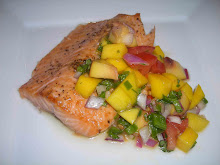
Salmon with Marsala Sauce

My Carolina Kitchen quietly celebrated its 8th blogging anniversary this past October. I feel that 8 wonderful years is a respectable time to say good-bye.

I am not planning on disappearing totally. I hope, from time to time, to post some of our new favorite recipes on My Carolina Kitchen 's Facebook page, link here, and hope you'll follow along.  altogether.

Blogging has been a wonderful journey for me and brought great pleasure into our lives. I have truly enjoyed getting to know each of you and I thank you for your continued support of My Carolina Kitchen. Along the way Meakin and I have been fortunate enough to have met a number of you in person and we will always treasure those friendships.

Before I say my final good-bye, I would like to share an idea with you. In the last several months I’ve been creating new recipes from old favorites. This idea is not novel or new, but I’ve found it to be truly rewarding and I think you will too.

Here’s how it works – find one of your favorite recipes, choose a component from it, and take that component to create a new recipe.

As an example, I choose Pork Marsala and took the Marsala sauce from Pork Marsala, link here, as the component and, instead of serving it over pork, I served it over salmon.

Pork Marsala


What I discovered was that the Marsala sauce was equally as delicious on salmon as it was on pork. Take a look.

Salmon with Marsala Sauce


Broiled Salmon with Marsala Sauce
Adapted from Pierre Franey, 60 Minute Gourmet & First Home Love Life – serves 4 
Printable Recipe 

1 1/2 pounds boneless fresh salmon fillets, preferably with the skin intact
2 to 3 teaspoons grape seed oil, or other neutral tasting oil
Kosher salt or sea salt & freshly ground black pepper

Cut the salmon into four pieces approximately the same size and weight. Put salmon on a plate, rub with oil, season with salt & pepper, and allow the salmon to sit at room temperature for 10 to 20 minutes.

Preheat the broiler. Arrange the salmon in one layer, skin side down, on an unheated sheet pan lined with heavy duty foil for easy clean-up. Place the salmon under the broiler about six to seven inches from the source of heat. Broil 8 to 10 minutes or just until the pieces are cooked through. It is not necessary to turn the salmon. If salmon starts to get too crispy on the top, change from broil to bake and bake at 400 degrees until done. Do not overcook or the salmon will be dry. Allow to rest for a few minutes, then  serve with the Marsala sauce.

Marsala Sauce 
Slightly adapted from First Home Love Life, serves 4
Printable Recipe

2 tablespoons extra-virgin olive oil
2 tablespoons butter
8 ounces sliced baby bella mushrooms
2 peeled and thinly sliced shallots
2 peeled and chopped garlic cloves
½ cup dry Marsala wine
½ cup low-sodium, low fat chicken broth or homemade
1 tablespoon chopped fresh thyme leaves or 1 teaspoon dried
4 fresh thyme sprigs for garnish

Heat olive oil and butter in a 10” non-stick skillet over medium-low heat. Add the mushrooms and sauté, stirring occasionally until they have rendered their juices and are brown. Add shallots and garlic and cook for 1 – 2 minutes more, taking care that the shallots and garlic don’t burn. Add the Marsala wine and chicken broth. Using a wooden spoon, scrape up the fond (brown bits) from the bottom of the pan. Add the chopped fresh thyme, stir to incorporate, then cover the pan and let simmer for about 5 to 8 minutes more.

If the sauce has not thickened to your liking, make a slurry of arrowroot (or cornstarch) and cold water and mix equal parts of arrowroot and water in a small dish and stir with a spoon. Then stir the slurry into the sauce until the sauce is sufficiently thickened. Serve hot. This sauce goes well with pork, salmon or chicken.

Chicken Marengo

Another new recipe was created from another old favorite – Chicken Marengo, shown above, link here. I took the Marengo sauce and served it over lean, bone-in pork chops and it too was a hit. (I apologize for no photo – the dish was half gone before I remembered to photograph it.)

Marengo Sauce
Slightly adapted from “With a Jug of Wine” by Morrison Wood, serves 4
Printable Recipe

2 tablespoons olive oil
4 small white onions, peeled & chopped
1 small clove of garlic, minced
1 ½ cups sliced fresh mushrooms
2 tablespoons minced parsley
4 tomatoes, peeled and sliced (canned, crushed first, are fine, including their juices)
1 cup dry white wine
1 tablespoon brandy
1 tablespoon tomato paste
1 tablespoon flour
Chopped fresh flat-leaf parsley for garnish

Heat olive oil in a large non-stick skillet over medium heat and sauté chopped onions, garlic, mushrooms, parsley in 2 tablespoons olive oil. Cook this mixture, stirring occasionally, until the mushrooms are tender. Add the tomatoes and their juices, dry white wine, brandy, tomato paste and 1 tablespoons flour. Mix and blend the ingredients well and allow to simmer over a medium flame for about 20 to 25 minutes. Serve the sauce hot over pork chops or chicken breasts garnished with chopped parsley.

You get the idea I’m sure. Here’s another example of taking a component from one recipe and trying it in another.

Chicken Provencal


I chose a Provencal sauce as the component and, instead of serving it over chicken, (link here) I served it over pork and it was excellent as well.

So voila, as you can see, new recipes can be created from old favorites and at the same time your recipe file will expand. Creating new recipes is rewarding and fun experiment. I hope that you’ll give it a try.

For better viewing, chick photos to enlarge.

Before I go, once again I want to thank each of you for your support of My Carolina Kitchen through the last 8 years. I hope that you’ll continue to try new recipes as well as experimenting with old ones. I know I plan to l continue to do the same.

I'm not planning to totally disappear. From time to time I plan to post some  of our new favorite recipes on My Carolina Kitchen's Facebook page, link here, and I would love it if  you to followed along.

I’ll leave you with some wise words from Julia Child.

Moderation. Small helpings.
Sample a little bit of everything. These are the secrets of happiness and good health.

- Julia Child

Wednesday, April 6, 2016

Pat Conroy’s Crab Cakes - his legacy to the food world


Pat Conroy, one of the great writers of our time, passed away this last March at this home in Beaufort. He wrote many best sellers including Beach Music, South of Broad, and of course The Great Santani. In honor of Pat, I am revisiting his fabulous crab cake recipe today. The original post titled “How to Make Great Crab Cakes” is from back in 2014 and can be found here. Pat was not only a wonderful writer, he also knew his way around the kitchen. Anytime Pats name comes up in a conversation, I always ask, “Have you read his cookbook?” And the answer invariably is, “No, I didn’t know he wrote a cookbook.” Well he did and it’s called The Pat Conroy Cookbook, Recipes of My Life. The book is filled with top quality recipes, but to me the best part of the book is the stories he shares about the recipes. The book is a novel within a cookbook. And his crab cake recipe is one of the best recipes in his cookbook and I believe his legacy to the food world.

A cute story I’ll pass along about Pat’s crab cakes. His wife novelist Cassandra King says that Pat said to her when they first met that, his crab cakes are so good I’ll want to marry him after tasting them. They were and I did". True story.

Photo from Amazon 
When it comes to crab cakes, in my opinion most crab cakes fall into one of two categories – they are either “great” or “not-so-good”. It’s not difficult to pinpoint what’s wrong with the “not-so-good” ones – they’re either over-cooked or under-cooked, too greasy, or so full of fillers that the sweet taste of the fresh crab doesn’t come through.


But what makes a crab cake “great?” I believe the secret is in the preparation.

First and foremost, don’t load the crab cakes with a bunch of fillers, such as crushed crackers or lots of breadcrumbs.  When you buy an expensive, quality ingredient like fresh lump meat crab, you want to taste the crab and not much of anything else. Also I beg you, please don’t substitute canned crab or fake crab. Buy the best lump crab you can afford.

Second, when you’re assembling the crab cakes, don’t over handle them. The best way I’ve found to mix the ingredients together is to use your hands. How many times have you heard that clean hands are the best tools in your kitchen? This is one of the times your hands beat any other utensil in the kitchen.

Third, chill the crab cakes in the refrigerator for an hour or so.  Because you aren’t using fillers, you don’t have much a binder in this recipe to hold the cakes together, so chilling is essential.

The last and possibly the most important thing that I’ve learned for perfectly cooked crab cakes is from Pat Conroy. In his book The Pat Conroy Cookbook, Recipes of My Life, Pat shares the “southern secret” for perfect crab cakes, Pat says:

1) The fat must be sizzling hot when you add the crab cakes
2) Cook the cakes for two minutes on each side and
3) Turn them once.

That’s Pat’s secret, pure and simple.

A quick tip – a thin fish spatula, such as the shown one below from Williams Sonoma, is the perfect tool for lifting and turning delicate cakes or any fish to prevent them from falling apart. It’s an essential and inexpensive tool if you cook a lot of seafood, which we do. It’s also perfectly designed for flipping fried eggs.

Fish spatula from Williams Sonoma

Today I’ve made my version of Pat’s crab cakes, following all of the ideas above, but I urge you to try Pat’s recipe from his cookbook, which can be found here. I like just a couple of squeezes of fresh lemon juice on my crab cakes, but Pat has a little bit fancier sauce napped with a lemony butter sauce and capers that’s also delicious and can be found here & here.

Enjoy!


Pat Conroy’s Crab Cakes
Adapted slightly from The Pat Conroy Cookbook – makes 8 cakes
Printable Recipe

1 pound lump crabmeat, picked over & cleaned, with all shell fragments removed
1 egg white, lightly beaten until just foamy but not stiff
1 tablespoon flour
2 tablespoons finely chopped scallions, white part only (or finely chopped chives)
1 teaspoon freshly ground black pepper
Several sprinkles of hot sauce to taste (I used Tabasco)
Small, small dash of Worcestershire sauce, taking care not to overpower the delicate flavor of the crabmeat
Pinch of Old Bay crab boil seasoning
2 teaspoons kosher salt (divided)
3 tablespoons unsalted butter
2 teaspoons peanut oil (don’t use olive oil, it will overpower the taste of the crab)
Lemon wedges

Place the cleaned crabmeat in a medium mixing bowl. Pour the foamy egg white over the crabmeat slowly, stopping occasionally to mix it through. When the crabmeat has absorbed the egg white and feels slightly sticky to the touch (about 30 seconds or so), dust the flour over the crabmeat, then sprinkle the chopped scallions, freshly ground black pepper, hot sauce, Worcestershire sauce, Old Bay, and a scant teaspoon of salt evenly over the top of the crabmeat.

With clean hands lift the crabmeat from the bottom of the bowl, turning over very gently with your hands to mix the ingredients, taking care not to over handle the crab. Separate into 8 equal portions and gently roll each between the flattened palms of your hands to form loose balls. Flatten slightly and transfer to a plate. Sprinkle both sides with the remaining teaspoon or less of salt, cover gently with wax paper, and (very important) refrigerate the cakes for at least one hour before cooking.

Line a baking sheet large enough to hold 8 crab cooked cakes with paper towels and set aside. Melt half of the butter and oil together in a heavy, 10” non-stick skillet, until the mixture is foamy and begins to brown. Cooking the crab cakes in two batches, carefully place 4 of the crab cakes in the hot fat and fry until a crust forms, turning only once, about 2 minutes per side.

Remove the crab cakes and drain on the prepared pan. Cover loosely with aluminum foil to keep warm while you make the second batch. To prepare the pan for the second batch, carefully pour off the cooking fat from the first batch and discard, wipe out the pan, and return to the heat. Prepare the second batch of crab cakes using the remaining butter and oil. Serve hot with lemon wedges. Our favorite way to serve them is on baby arugula, but watercress or baby greens are equally good.

For better viewing, click photos to enlarge.

I will be sharing this recipe with Foodie Friday at Rattlebridge Farms and Miz Helen’s Country Kitchen’s Full Plate Thursday.

Have a great week  
& thank you for visiting My Carolina Kitchen.

Thursday, April 9, 2015

Spanish Chicken, Rice, Shrimp & Chorizo turned into a mock Paella


This dish began as a simple Spanish chicken and rice dish and by adding some saffron, Spanish chorizo and shrimp I was able to turn it into a party friendly version of mock Spanish paella. It’s a flavorful one dish meal that comes together in less than an hour. To round out the meal, serve with a crusty baguette, a lightly dressed green salad and pour a good Spanish red wine from the Rioja region.


If you research paella on the internet, you’ll find many versions. I found this one from Tio Peppe’s restaurant in Greenwich Village very attractive and a doable presentation for a home cook. If you look at their paella picture here, you’ll see that the Chef garnished his paella with well placed slices of roasted red peppers, then sprinkled green peas atop the red peppers and a few slices of Spanish chorizo were strewn about to give the dish a big pop of color and flavor. I noticed that he chose to serve the paella in a dark bowl, which I also found appealing from a color standpoint. So there’s no stopping what you can do with a simple base of chicken and rice simmered together in a tomato and wine sauce.


Spanish Chicken, Rice, Shrimp & Chorizo turned into a mock Paella
Adapted from Real Simple – serves 4
Printable Recipe

1 tablespoon olive oil
1 pound boneless, skinless chicken breasts, trimmed of excess fat & cut into 2 ½” inch pieces
Kosher salt
Freshly ground black pepper
1 medium yellow onion, sliced
1 red bell pepper, chopped
2 cloves of garlic, finely chopped
1 cup dry white wine
1 28-ounce can whole tomatoes, crushed & torn into pieces, including liquid
¼ teaspoon dried saffron, crumbled (optional)
1 cup long-grain white rice
¾ pound peeled & deveined wild caught shrimp (optional)
1 cup frozen green peas
¼ cup pimento-stuffed Spanish olives, cut in half
4 to 5 ounces Spanish chorizo, roughly diced (optional)
¼ cup flat-leaf parsley, roughly chopped + extra sprigs for garnish

Heat the oil in a large saucepan over medium heat. Pat the chicken dry with paper towels. Season with salt and freshly ground black pepper and cook until golden brown, 2 minutes per side.

Add the onion and bell pepper and cook, stirring occasionally, until soft, about 5 minutes. Add the garlic and cook, stirring, for 1 minute. Add the wine, tomatoes and their liquid, saffron, rice, salt, and freshly ground black pepper and bring to a boil. Reduce heat and simmer, covered, for 15 minutes, or until 5 minutes before the rice is done. Stir in shrimp and continue to cook for 5 more minutes until rice & shrimp are done.

Stir the peas, olives, & chopped chorizo into the rice and chicken and cook, covered, until heated through, about 2 minutes. Spoon the chicken and rice into a platter or onto individual plates and sprinkle with the parsley. If desired, garnish with a sprig of parsley.


For better viewing, click photos to enlarge.

This will be shared with Foodie Friday at Rattlebridge Farm and Miz Helen’s Country Kitchen Full Plate Thursday.
Have a great weekend everyone.

Thursday, March 26, 2015

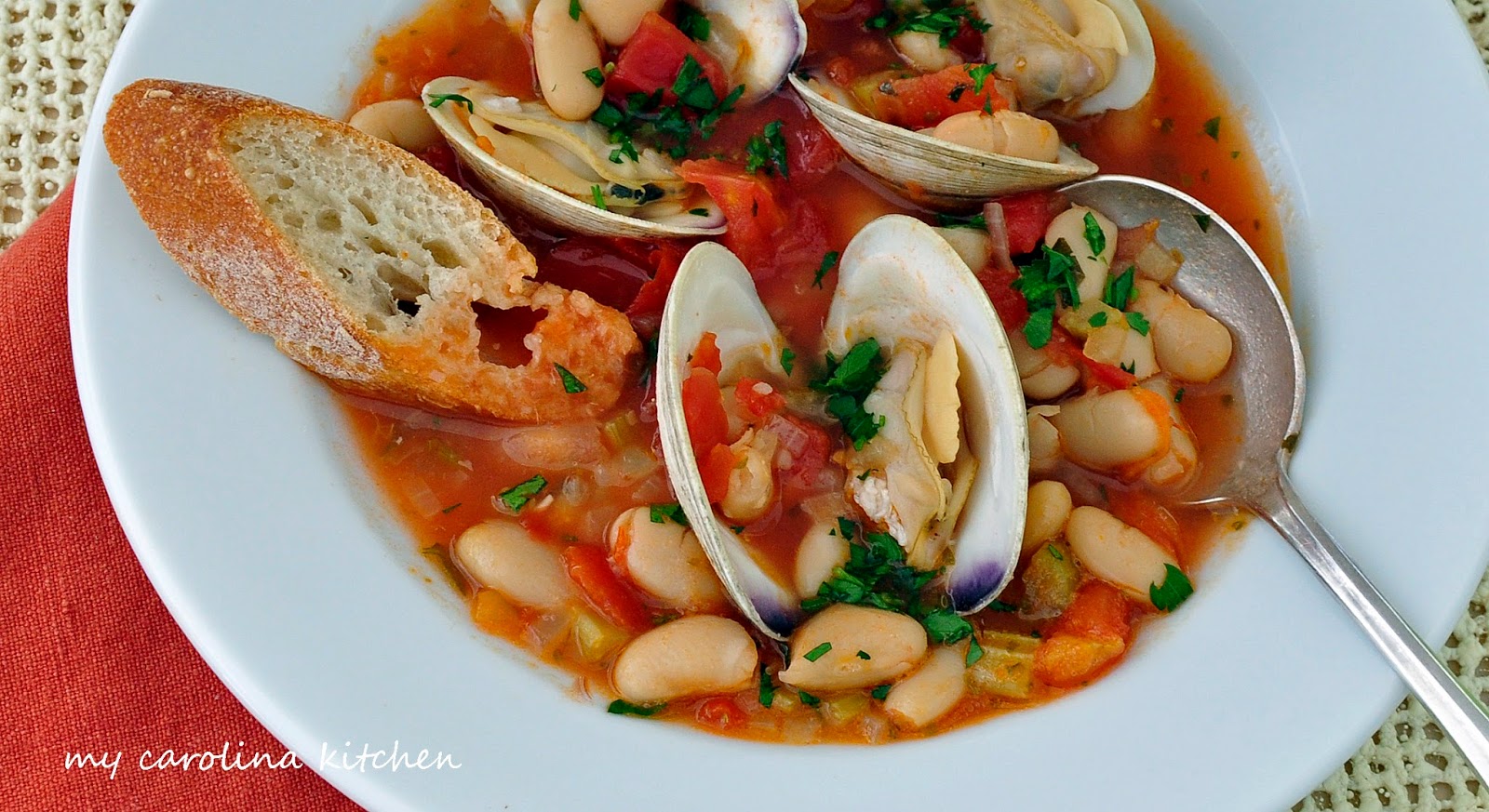
Steamed Clams Fagioli


This dish is a takeoff of the Italian peasant dish Pasta Fagioli, but steamed clams take the place of the pasta found in a traditional Fagioli. It’s loaded with the classic Italian flavors found in most Fagioli recipes and can be prepared in 30 minutes.

Fagioli has become so popular in American today that it’s widely found even in restaurants that don’t specialize in Italian cuisine. According to Wikipedia, the word for beans varies in the different Italian dialects so much that fagoli is it often pronounced differently. Pastafazoola, a song written by Van & Schenck, used the Neapolitan pronunciation for the rhyme - “Don’t be a fool, eat pasta fazool.” Whenever I hear the word fazool, it always reminds me of the line in Dean Martin’s song That’s Amore - “When the stars make you drool, just-a like a pasta fazool, that’s amore.” 


Meakin has his own way of steaming clams and that’s how we prepared them for this recipe so we would have fresh clam broth instead of having to use bottled clam broth. If you plan to use your own method to steam the clams, you’ll want to steam the clams first before you proceed with the recipe and add them at the end when you’re plating. Otherwise, just follow the recipe as written below. For a less soupy version, use the recommended ½ can of the tomatoes and beans.

We are crazy about steamed clams and thought this dish definitely fell into the “have-again” category. It is lighter and less filling than the traditional pasta fagioli and frankly we didn’t miss the pasta at all. Plus we’re always glad to welcome another 30 minute meal into our repertoire. Don’t forget the slices of a toasted baguette to sop up all of the delicious juices.


Steamed Clams Fagioli 
Adapted from Cooking Light, serves 4, can be prepared in 30 minutes
Printable Recipe

1 1/2 teaspoons olive oil
1 garlic clove, minced
1/4 cup finely chopped onion
2 tablespoons finely chopped celery
1/8 teaspoon crushed red pepper
2 tablespoons dry white wine
1/2 (14.5-ounce) can diced tomatoes, undrained (I used entire can)
1/3 cup fat-free, lower-sodium chicken broth
2 tablespoons clam juice
1 1/2 teaspoons chopped fresh parsley
1/4 teaspoon dried oregano
Dash of kosher salt & freshly ground black pepper
1/2 (15.5-ounce) can cannellini beans, rinsed and drained (I used entire can)
12 littleneck clams
4 (1/2-inch-thick) slices French bread baguette (about 4 ounces), toasted

Heat the oil in a medium saucepan over medium-high heat. Add garlic; sauté 1 minute, stirring frequently. Add onion and celery; sauté for 1 minute, stirring frequently. Add red pepper; cook 1 minute. Stir in wine; cook 1 minute. Stir in tomatoes; bring to a simmer. Cook 5 minutes, stirring frequently. Add broth, clam juice, parsley, oregano, salt and pepper and drained beans. Bring to a boil. Cover and reduce heat & simmer 2 minutes. Add clams to pan. Cover and cook over medium-high heat 5 minutes or until clams open (be sure discard any clams whose shells don’t open.) Ladle 2/3 cup soup into 4 bowls & top each with 3 clams. Serve with slicked of toasted baguette  to mop up the broth.


For better viewing, click photos to enlarge.

This will be shared with Foodie Friday at Rattlebridge Farm, Miz Helen’s Country Kitchen Full Plate Thursday & Food on Friday at Carole's Chatter.
Have a great weekend everyone.

Easter recipes early next week. Stay tuned.


Thursday, August 14, 2014

Broiled Salmon with Fresh Red Cherry Sauce


Cherries have been excellent this year and are still available in the market. I’ve used them in several recipes, most recently a baby greens salad with fresh cherries, gorgonzola cheese, and chicken with a raspberry vinaigrette, link here. The other night we dipped fresh cherries in chocolate. Ooh, la, la. I’ve been very impressed with this season’s cherry crop.

This recipe says it take only 15 minutes to prepare, but the original recipe called for frozen pitted cherries. If you use fresh cherries, which I highly recommended when they are this good, it will take a little longer to prepare because you have to pit fresh cherries. I also inserted my method of broiling salmon, which takes a little longer than the original recipe called for because I like the salmon to rest. We put our own twist on the sauce by adding a little honey and port wine. Right before serving the sauce when it’s off of the heat, adding a knob of butter will to give the sauce a nice shine.


When we cook for two people from a four person serving recipe and it has sauce, we decrease the meat of course, but always make the entire sauce. One, we love sauce and two, most sauces are good left-over on or in scrambled eggs in the morning. If you have some of this fresh cherry sauce left over, we can attest to the fact that it is great on vanilla or chocolate ice cream.

We served green beans topped with toasted almonds and brown rice sprinkled with Spanish paprika to complete the meal. Bon Appétit!


Broiled Salmon with Fresh Red Cherry Sauce
Adapted from The Complete 15-Minute Gourmet by Paulette Mitchell – serves 4
Printable Recipe

For the fish:
4 6-ounce salmon fillets, preferably with the skin left intact
2 to 3 teaspoons grape seed oil, or other neutral tasting oil
Kosher salt or sea salt & freshly ground black pepper

For the sauce:
12 ounces fresh red cherries, pitted (or 12 ounce package frozen pitted red cherries)
½ cup fresh orange juice
1 teaspoon cold water
1 teaspoon cornstarch
1 tablespoon raspberry vinegar
1 teaspoon extra-virgin olive oil
¼ teaspoon kosher salt
2 teaspoons honey
3 tablespoons port wine
A knob of butter

Cut the salmon into four pieces approximately the same size and weight. Put salmon on a plate, rub with oil, season with salt & pepper, and allow the salmon to sit at room temperature while you heat the broiler.

Preheat the broiler. Arrange the salmon in one layer, skin side down, on an unheated sheet pan lined with heavy duty foil for easy clean-up. Place the salmon under the broiler about six to seven inches from the source of heat. Broil 8 to 10 minutes or just until the pieces are cooked through. It is not necessary to turn the salmon. If salmon starts to get too crispy on the top, change from broil to bake and bake at 400 degrees until done. Do not overcook or the salmon will be dry. Allow to rest for a few minutes (I leave it for at least 5 minutes) before serving.

While the salmon is cooking, combine the cherries and orange juice in a small saucepan over high heat. Cook, stirring occasionally, for 3 minutes, then reduce the heat to medium. Make cornstarch slurry by stirring together the water and cornstarch in a small bowl until smooth. Add the slurry to the saucepan and stir for 2 minutes or until thickened to a maple-syrup consistency, about 1 ½ minutes to remove the “corn starchy flavor”. Stir in the vinegar, oil, honey and port wine and heat for a moment or two. If the sauce isn’t the right consistency, make a little more corn starch slurry. Add the additional slurry and stir for about 2 minutes to obtain the right consistency. Remove the sauce from the heat and add a knob of butter to give the sauce a shine. To serve, transfer the salmon fillets to plates and top with the warm cherry sauce.

For better viewing, click on photos to enlarge.

This will be shared with Foodie Friday at Rattlebridge Farm, Miz Helen’s Country Kitchen Full Plate Thursday, Foodie Friday at Simple Recipes & Food on Friday at Carol's Chatter.    
Have a great weekend everyone.


Thursday, June 19, 2014

Mediterranean Salmon Salad


This Mediterranean salmon salad is an interesting combination of part green salad and part pasta salad, neither of which overwhelm nor dominate the other. Flaking the salmon allows a rather small amount of fish to go a long way in this recipe, which is nice if you consider the price of fresh fish today. Other kinds of seafood such as crabmeat, chopped shrimp, and grouper would work equally well if you wish to stay on the seafood theme. Or I know I would like this salad with chunks of white chicken.


Have you ever forgotten an ingredient in a recipe and found it worked better without it? That’s exactly what happened here. The first time we made this salad I completely forgot to garnish it with the feta cheese. As I downloaded the pictures I noticed something was missing and discovered it was the cheese. A few days later we made the salad again and to our surprise, we thought the cheese dominated the salad and was better without it. Mistakes sometimes work out for the best and it’s your choice as to whether to include the feta or not.

Salmon is on the menu frequently at our house so instead of cooking the salmon especially for this salad, we used left-over broiled salmon. In the instructions below I’ve included my tried and true method of how to broil salmon that works perfectly every time. Using left-over salmon works great and it makes putting together the recipe go even faster, but just be sure to let the salmon come to room temperature. Don’t be tempted to leave out the red bell pepper. It gives the salad a nice crunch. As summer approaches, this salad is perfect for a main course lunch or a light dinner.


Mediterranean Salmon Salad
Adapted from My Recipes, serves 4
Printable Recipe

2 (6 ounce) salmon fillets, about 1” thick in the middle
Grape seed oil, or other neutral tasting oil
Kosher salt
Freshly ground black pepper
¼ teaspoon dried oregano
½ cup uncooked orzo
2 cups torn baby greens or baby spinach leaves
½ cup chopped red bell pepper
¼ cup chopped scallions
6 kalamata olives, pitted and chopped
3 tablespoons freshly squeezed lemon juice
2 tablespoons crumbled feta cheese, optional – I did not use the cheese

Place salmon on a plate, rub with oil, then season with salt, oregano & freshly ground black pepper and allow to sit at room temperature for 10 to 20 minutes.

Cook the orzo according to package instructions, omitting the fat if you wish. Drain, rinse and set aside covered while salmon cooks. In the meantime, preheat the broiler.

Arrange the salmon, skin side down, on an unheated sheet pan lined with heavy duty foil for easy clean-up. Place the salmon under the broiler about six to seven inches from the source of heat. Broil 8 to 10 minutes or just until the pieces are cooked through. It is not necessary to turn the salmon. If salmon starts to get too crispy on the top, change from broil to bake and bake at 400 degrees until done. Do not overcook or the salmon will be dry. Allow to rest for a few minutes, then flake with two forks, leaving behind the skin to discard.

To assemble the salad, combine the drained orzo, lettuce, flaked salmon and remaining ingredients in a large bowl and toss well. Garnish with crumbled feta cheese if using.


This will be shared with Foodie Friday at Rattlebridge Farm, Miz Helen’s Country Kitchen Full Plate Thursday, and Foodie Friday at Simple Recipes.  

Have a great weekend everyone.


Thursday, April 24, 2014

Spicy Coconut Shrimp Soup


This soup has a bit of spice yet a good balance of Asian flavors. Adding a big squeeze of lime juice and slivers of fresh basil just before serving always brightens a dish. It’s a wonderful way to welcome spring into your kitchen.

While ginger, fish sauce and spicy red curry paste bring the flavors to this dish, the shrimp is the real star. I encourage you to seek out wild caught shrimp, even if it has been frozen, and try to avoid foreign shrimp, which to me has a strange “off” flavor and often the texture of the shrimp is soft. It’s the quality of the shrimp that counts, not the fact that it’s been frozen.

For many years we were spoiled living near the Gulf of Mexico where some of the best shrimp in the world is harvested. I can remember buying freshly caught shrimp with their heads still on packed in lots of fresh ice from big Igloo coolers in the back of pick-up trucks on the side of the road in south Louisiana. Heads on shrimp are THE very best of the best and you can’t fake freshness when you can see their heads. We’ve now discovered that the coast of the Carolinas also has wonderful fresh caught wild shrimp. I’m not saying only buy Gulf of Mexico or Carolina shrimp or never buy frozen. What I am saying is ask your fish monger where the shrimp is from or read the label so you’ll know what you are buying. Try to avoid those bags of frozen shrimp that come from who-knows-where. Good quality seafood is not cheap, so buy the best you can find. Cheap seafood is just that, cheap.


Spicy Coconut Shrimp Soup
Adapted from Cooking Light – serves 4 

3 ½ cups fat-free, low sodium chicken broth
1 cup sliced button mushrooms
¼ cup finely chopped red bell pepper
1 tablespoon light brown sugar
1 tablespoon fish sauce
½ teaspoon peeled and grated fresh ginger
¼ teaspoon red curry paste, more if you like it really spicy
1 cup light coconut milk (shake well before measuring)
1 pound large shrimp, preferably wild caught, peeled and deveined
¼ cup chopped fresh cilantro
2 tablespoons thinly sliced fresh basil
2 tablespoons freshly squeezed lime juice
Slices of lime and cilantro sprigs for garnish if desired

Combine chicken broth, mushrooms, chopped red pepper, brown sugar, fish sauce, grated ginger and curry paste in a large saucepan over medium-high heat and bring to a boil. Cover, reduce heat, and simmer for 10 minutes. Stir in coconut milk and cook for 2 minutes until hot. Add shrimp, cook for 3 minutes or until the shrimp are done. Remove the pan from the heat, stir in the cilantro, basil and lime juice, garnish if desired, and serve right away.


This will be shared with Foodie Friday at Rattlebridge Farm, Miz Helen’s Country Kitchen Full Plate Thursday, Foodie Friday at Simple Recipes, Comforts of Home Tasty Tuesday & Food on Friday at Carole's Chatter.   

For better viewing, click photos to enlarge.

Have a great weekend everyone.

Wednesday, April 9, 2014

Salmon & Asparagus Bundles


These salmon and asparagus bundles always catch my eye each time I see them in the showcase of our local favorite seafood market Merrick’s in Cape Coral, Florida. Merrick’s is one of southwest Florida’s finest purveyors of fresh seafood (they service over 250 local restaurants) and they also have ready-to-go seafood dishes for take-out. Take a glimpse inside the seafood market here and you’ll see why we are so proud to have them in the area. In a large room behind the retail counter you can see fish cutters busily filleting freshly caught local fish from the Gulf of Mexico. Last year they opened Fish Tails, their own fabulous seafood restaurant next door to the seafood market, photos of some of their gorgeous dishes here. Now you can understand why we eat a lot of fresh seafood and why you see a lot of seafood recipes on My Carolina Kitchen. Both Merrick's Seafood Market and Fish Tails restaurant are a "do-not-miss" if you are in the greater Fort Myers / Naples area.

I finally decided to make my own salmon and asparagus bundles. The ones at Merrick’s have a bourbon glaze (see here), but I was in the mood for something a little tropical, so I chose Soy Vay’s Island Teriyaki sauce for my glaze. The glaze is made of made with 100% pure pineapple juice, zesty ginger and fresh garlic and even if I tried, I don’t think I could do better if I had made my own. I always have a bottle in the refrigerator and use it often as a glaze on salmon or grouper, as an example. Soy Vay’s Island Teriyaki is available in many supermarkets, including Fresh Market, and on line at Amazon.

Soy Vay Island Teriyaki

These bundles can be made in advance and cooked at the last minute, which makes them convenient for entertaining. The salmon should be skinned before wrapping the asparagus. Your fishmonger can do this for you or it’s relatively easy if you have a sharp boning knife. I sprinkled my bundles with some black and white sesame seeds before popping them in the oven.


Salmon & Asparagus Bundles
Inspired by Merrick’s Seafood in Cape Coral, Florida, easily doubled or tripled, serves 2

Fresh asparagus spears, about 5 to 6 per person depending on size
½ to ¾ pound fresh salmon, preferably the tail end that isn’t too thick
Kosher salt
Freshly ground black pepper
Soy Vay’s Island Teriyaki sauce for brushing, about 1 tablespoon per fish
Black sesame seeds
White sesame seeds, optional

Preheat the oven to 350 degrees F. Line the asparagus up so the ends are even and using a sharp knife, cut off the bottom inch or so to remove the dried ends. Peel the remaining ends with a vegetable peeler, then separate into two bundles.

If the salmon has skin, remove with a very sharp filet knife (your fish monger can do this for you if you wish). Sprinkle the salmon with salt and freshly ground black pepper, then wrap around an asparagus bundle. Brush the salmon with the teriyaki sauce and sprinkle the top with sesame seeds. Place on a sheet pan that has been lined with heavy duty foil (for easy clean-up). Bake for 20 minutes, then remove and check for doneness. Serve right away.

Cook’s notes: If your asparagus is thick, you may wish to parboil it for a minute or so before wrapping it with the salmon. If the asparagus tips are dainty, you might want to brush their tips with a tiny bit of olive oil to prevent their drying out.


This will be shared with Foodie Friday at Rattlebridge Farm, Miz Helen’s Country Kitchen Full Plate Thursday, Foodie Friday at Simple Recipes, Comforts of Home Tasty Tuesday, and Food on Friday at Carole's Chatter.   

I will be back early next week with a medley of asparagus recipes that are perfect for Easter or any time actually. Until then, have a great weekend. 

Thursday, April 3, 2014

Pan-Seared Scallops with Sautéed Oranges


This colorful dish looks like sunshine and it transitions well from late winter into spring. Winter oranges are still available and seafood always reminds of spring and being out on the water boating when the weather warms up. It would also make a lovely lunch during Easter weekend when you're looking for something fresh and light. Blood oranges would be a striking combination to the navel oranges, but when I went to the market, I found I had missed their season. I’ve made a note to try this recipe again when I see blood oranges in the market next year.

The citrus flavors make a refreshing counterpoint to the rich seared sea scallops. Scallops aren’t particularly difficult to prepare. You just need to be very careful not to overcook them, because if you do, they will be tough and chewy and very unappetizing.


I think the most difficult thing about scallops is finding the correct ones. Dry pack scallops are the very best money can buy and I encourage you to seek them out. Here's a link that will explain what dry pack scallops are. If at all possible you want to avoid scallops that have been soaked in brine. Why? Because they are very difficult to near impossible to brown properly and, to me, they leave a bit of a tangy aftertaste in your mouth. Scallops should smell and taste like the sea – fresh.

I upped the amount of oranges called for in this recipe because the navel oranges I’ve been buying have ended up small by the time I removed their skin. If it turns out you’ve bought an extra orange or two, no problem, just juice them for breakfast the next day. The oranges in this recipe are briefly sautéed just to heat them through, so take care not to overcook them. The olives were a last minute idea for our own special touch because we think that the brininess of olives pairs well with citrus.


Pan-Seared Scallops with Sautéed Oranges
Adapted from Williams-Sonoma Cooking from the Farmers’ Market, by Tasha DeSerio & Jodi Liano, serves 4

Printable recipe

4 navel oranges, or 2 navel oranges and 2 blood oranges
Kosher salt
Freshly ground black pepper
½ teaspoon ground cumin
1 pound large dry-packed sea scallops
1 tablespoons extra-virgin olive oil
2 teaspoons sherry vinegar
1 tablespoon unsalted butter
2 teaspoons fresh cilantro leaves (or parsley if you don’t care for cilantro)
Assorted French olives, optional but delicious

Peel the oranges and cut into thin rounds, reserving the juice, and set aside.

In a small bowl combine the cumin and a pinch of salt and freshly ground black pepper. Dry the scallops with a paper towel and sprinkle with the seasoning mixture. In a non-stick skillet over medium heat, warm the olive oil. Add the scallops and cook until browned underneath, about 1 to 2 minutes. Turn and cook until just firm to the touch but still translucent in the center, about 1 to 2 minutes more. Take care not to over-cook the scallops or they will be tough. Transfer the scallops to a plate and keep warm.

Add the vinegar and reserved orange juice to the pan and cook until reduced by half, then add the orange slices and cook for 1 minute. You are just warming the oranges, not actually cooking them. Remove the pan from the heat and stir in the butter. Return the scallops to the pan along with any accumulated juices and stir to coat with the sauce. Transfer the oranges to serving plates and top with scallops. Sprinkle with cilantro leaves and assorted French olives if using. Serve immediately.

This will be shared with Foodie Friday at Rattlebridge Farm, Miz Helen’s Country Kitchen Full Plate Thursday, & Foodie Friday at Simple Recipes.  
Have a great weekend everyone.

Thursday, March 27, 2014

Mussels Throwdown – Thai Coconut & Basil vs. French Moules a la Mariniere


I thought it might be fun to have a throwdown with mussels – Thai coconut basil mussels vs. French Moules a la Mariniere, or mussels in white wine. Mussels in white wine are a specialty of my husband Meakin and the Thai coconut basil mussels recipe is one we recently tried from Cooking Light.

Both recipes are very easy and can be put together in 30 minutes. I’m always surprised when I hear people say they think mussels are difficult to prepare and it’s just not true. Cultivated mussels can be found in most supermarkets today and no longer have beards so they don’t have to be cleaned as they once did.

In the Thai coconut mussel dish we added lemongrass for a bit more flavor, but if you can’t find lemongrass, don’t worry. It’s not absolutely necessary because the fish sauce adds a nice layer of flavor and the lime juice perks up the sauce. I find that if fresh basil is heated it turns black, so we waited until the last minute to add it. This is a very light and colorful dish and if you want to make it a bit more substantial, you can serve it with scallion rice.


Moules a la Mariniere, or mussels steamed in white wine, is a French classic bistro dish that you may remember from our archives and we serve it often. Meakin steams the mussels in a wine and chicken broth mixture, finishes them with tomatoes, cream and a dash of Pernod, an anise flavored French liquor, and dinner is served before you know it. We like to keep a bottle of Pernod on hand so we can use a splash of its citrusy anise flavor in seafood to give it a Mediterranean twist and a taste of Provence. In the south of France Pernod is sipped as an aperitif called pastis. Typically waiters bring small glasses of Pernod on a tray to your table with a pitcher of cold water for diluting the strong green liqueur, making it turn cloudy and yellow.

Pastis 
There is no doubt in our minds which of the two recipes won our vote for the throwdown – the French mussels in white wine. Moules a la Mariniere is a true classic and the flavors come together beautifully without overpowering each other. We never tire of eating it. The Thai coconut and basil mussels were light and make a nice dish to serve in the spring, but the flavors didn’t capture us in the long run and the sauce was a bit thin. We live to eat and are always trying new recipes, so no recipe ever goes to waste. But we might be just "a bit" prejudiced when it comes to the Moules a la Mariniere, so we would love to hear from you.


Coconut and Basil Steamed Mussels
Adapted from Cooking Light – serves 2
Printable recipe

2 teaspoons canola oil
¼ cup minced shallots
2 teaspoons minced garlic
1 cup light coconut milk
2/3 cup water
1/3 cup low sodium, fat free chicken broth
About a 3” piece of fresh lemon grass, 1" of the root end crushed with a knife, optional
1 tablespoon fresh lime juice
1 teaspoon dark brown sugar
1 teaspoon fish sauce
½ to 1 teaspoon Sriracha chili sauce
24 mussels, about 1 pound, scrubbed and de-bearded if necessary
Slivered fresh basil leaves

Heat a Dutch oven over medium heat and add oil to pan, swirling to coat. Add shallots and garlic to pan and cook 2 minutes or until tender, stirring frequently to make sure neither burn. Shake the can of coconut milk well, then stir in along with the milk, water, broth, lemon grass, lime juice, sugar, fish sauce and Sriracha and bring to a boil. Add the mussels to the pan, cover and cook 5 minutes or until shells open.

Remove mussels from the pan with a slotted spoon and reserve the broth mixture. Remove lemongrass and discard. When mussels are cool enough to handle, remove most of them from their shells and save a few with shells for presentation. Throw away any mussels that did not open. Bring broth to a boil and cook for 5 minutes. Divide the mussels between 2 serving bowls. Pour 1 cup of hot broth over each serving. Sprinkle with slivered fresh basil and serve right away. Nice with crusty bread for dipping or serve with scallion rice, recipe below.

Scallion rice
Combine 1 cup water, 1/2 cup jasmine rice, 1 teaspoon butter, 1/4 teaspoon kosher salt, and 1 thinly sliced green onion in a small saucepan; bring to a boil. Cover, reduce heat, and simmer 15 minutes; remove from heat. Let stand 5 minutes. Fluff with a fork.


Mussels in white wine a la Chez Meakin - Moules a la Mariniere 
By Meakin Hoffer from My Carolina Kitchen - serves 4
Printable recipe

3 pounds of small cultivated mussels, scrubbed and debearded if necessary
1 leek
2 cloves of garlic, finely chopped
2 tablespoons extra virgin olive oil
2 cups chicken broth (we like the low sodium & fat free variety)
1 cup dry white wine
1 - 14.5oz can whole tomatoes
½ cup of half & half or cream
2 capfuls of Pernod (optional)
Pinch of cayenne pepper
Kosher salt and freshly ground black pepper to taste
4 tablespoons chopped fresh Italian parsley

Rinse the mussels in water, scrub and de-bead if necessary. Cut the dark green leaves off of the top of the leek and discard them. You will be left with the light green leaves and white end. Cut the roots off of the white end and discard it also. Cut the remainder of the leek in half lengthwise, rinse well under running water to remove any dirt, and shake dry. Cut each half of the leek in half again and thinly slice.

Add the olive oil to a large non-aluminum stock pot and set the heat to medium. Sauté the leek and garlic in the olive oil for 3 to 5 minutes to soften, taking care not to brown. Add the mussels in their shells, chicken broth and wine to the stock pot and stir well. Raise the heat to medium high. Cover and cook for 8 to 10 minutes, or until the mussels open. Discard any mussels that do not open.

Remove the stock pot from the heat and allow the mixture to cool. When it is sufficiently cool, carefully remove the mussels from the liquid and pick them from their shells, leaving a few in their shells for a garnish.  Discard the remaining shells.

Add the mussels back to the liquid in the stockpot along with a can of whole tomatoes which you have gently crushed with your hands along with their tomato liquid. Stir, then bring the mixture to a boil, immediately turn the heat down to medium low and let it simmer about 10 minutes. Add the half & half, Pernod if using, a good pinch of cayenne pepper and salt and pepper to taste. Let it heat through. Serve immediately in bowls with chopped fresh parsley for garnish. Accompany with slices of a crusty French baguette for dipping.

* * *

Thank you for your kind words of encouragement with regard to my physical therapy. I've had therapy several times in the past and I've just started this round. It has been more painful than I expected and I hope to have that portion of the treatment corrected by the time you read this. Thank you again for caring. It means so much to me.

This will be shared with Foodie Friday at Rattlebridge Farm, Miz Helen’s Country Kitchen Full Plate Thursday, Foodie Friday at Simple Recipes, and Comforts of Home Tasty Tuesday.

Have a great weekend everyone.

Thursday, January 9, 2014

Italian Seafood Salad


We have been craving seafood after feasting on lots of meat during the holidays and ending with a gorgeous prime rib for Christmas. This Italian seafood salad is from Ina Garten, the Barefoot Contessa’s latest cookbook Foolproof


Ina uses a splash of Limoncello and lots of fresh lemon juice to bring out the briny flavor of the shellfish. Limoncello is a sweet liqueur from Italy and has a strong lemon flavor, but doesn’t have the sourness or bitterness associated with lemon juice. Limoncello is offered today in more and more restaurants as an after dinner digestive in place of dessert. Along the Amalfi Coast, the Italians serve Limoncello chilled in small ceramic glasses, the glasses themselves chilled as well. We like to keep a bottle in our freezer for that same occasion.  


The recipe calls for fresh calamari, which we love. Try as I might, including searching every seafood market within ten to fifteen miles, we weren’t able to locate any calamari. So we substituted two six-ounce small spiny lobster tails that we frequently we can find on sale in our local market for the calamari. This is a very rich salad and consequently we had some left-overs. The next day we added a large can of canned plum tomatoes and their juice along with a splash of white wine and turned it into a seafood stew. This is an expensive salad, so I suggest you save it for special occasions. 


Italian Seafood Salad
Adapted from Foolproof & The Food Network by Ina Garten – serves 6 to 8

1 tablespoon Old Bay seasoning
Kosher salt
1 1/2 pounds (16- to 20-count) shrimp, peeled and deveined 
2 spiny lobster tails, about 6 ounces each, optional
1 1/2 cups dry white wine
1 pound sea scallops, halved crosswise
1 pound cleaned fresh calamari, sliced crosswise in 1/2-inch-thick rings (or substitute 2 spiny lobster tails, about 6 ounces each as we did above)
2 pounds fresh mussels

Dressing:
1/2 cup good olive oil
4 teaspoons minced garlic (4 cloves)
2 teaspoons dried oregano
1/2 teaspoon crushed red pepper flakes
3 plum tomatoes, seeds and pulp removed and medium-diced
1/3 cup Limoncello liqueur
Grated zest of 1 lemon
1/4 cup freshly squeezed lemon juice (2 lemons)
Freshly ground black pepper
1 small fennel bulb, trimmed, cored, and thinly sliced crosswise
1/2 cup fresh flat-leaf parsley leaves, lightly packed
2 lemons

Fill a large pot with 3 quarts of water and add the Old Bay seasoning and 1 tablespoon of salt. Bring to a boil, add the shrimp & lobster tails and lower the heat. Simmer the shrimp for 3 minutes, until just firm. With a skimmer or slotted spoon, transfer the shrimp to a large bowl and leave the lobster tails in the water and simmer for an additional 3 minutes. With a skimmer or slotted spoon, transfer the lobster a large bowl and let rest until cool enough to remove the meat and cut into cubes. Save the tail for garnish if you wish. Leave 2 cups of the poaching liquid in the pot and discard the rest.

Add the wine to the poaching liquid and bring to a boil. Add the scallops, lower the heat, and simmer for 2 minutes, until just cooked. With the skimmer, transfer the scallops to the bowl with the shrimp. Bring the poaching liquid back to a boil, add the calamari, and simmer for 2 to 3 minutes, until just cooked. Be careful not to overcook any of the seafood or it will be tough. With the skimmer, transfer the calamari to the bowl.

Bring the poaching liquid to a boil again, add the mussels, cover, and simmer for 4 to 5 minutes, until all the shells have opened, discarding any that don't open. Turn off the heat and set aside until the mussels in the broth are cool enough to handle. Remove all but 12 of the mussels from the shells and add to the bowl. Add the 12 in their shells to the seafood and discard the rest of the shells. Set aside 1/2 cup of the poaching liquid, discarding the rest. Drain the seafood in a colander and put it all back into the bowl.

For the dressing, heat the olive oil in a medium (10-inch) sauté pan over medium heat. Add the garlic, oregano, and red pepper flakes and cook for 1 minute. (Be careful: Overcooked garlic will be bitter.) Add the tomatoes and cook over medium heat for 2 more minutes. Add the reserved poaching liquid, the limoncello, lemon zest, lemon juice, 1 tablespoon salt, and 1 teaspoon pepper and cook for 1 more minute. Pour the sauce over the seafood and toss gently. Add the fennel and parsley. Cut a lemon in half lengthwise, cut it thinly crosswise, and add it to the salad. Toss gently to combine and cover with plastic wrap. Chill, covered, for at least 3 hours or overnight.

To serve, sprinkle with 2 teaspoons salt, 1 teaspoon pepper, and the juice of the remaining lemon. Taste for seasonings and serve cold or at room temperature. Garnish with a lobster tail if desired.


This will be shared with Foodie Friday at Rattlebridge Farm, Miz Helen’s Country Kitchen Full Plate Thursday, Foodie Friday at Simple Recipes & Carol's Chatter Food on Friday. 

Have a great weekend everyone.