Thursday, February 25, 2016

The Barefoot Contessa’s Steak with Arugula


We have fallen head over heels in love with a hot juicy steak topped with cold peppery arugula dressed in a tart lemony vinaigrette and finished with sharp Parmesan cheese shavings. It’s a one-dish easy dinner that comes together in a snap and is from Garten’s How Easy is That?  You could call it Ina’s beef version of Parmesan Chicken Salad, which is also one of our all time favorites, featured here with the recipe and shown below. If you’ve fond of that recipe, you’re going to love the steak version.


Serving the greens really cold is the secret to this recipe. We filled a salad bowl with arugula and put it in the refrigerator to chill while the steak cooked and didn’t remove it until the steak was ready to slice. The contrast of the cold salad with the hot, juicy steak is like a well orchestrated party of opposites in your mouth. Trust me, you’re going to love it.

Thanks to a tip from our butcher at our local Publix supermarket, we have discovered a relatively inexpensive a cut of steak called a “shoulder tender.” It costs around $6.99 a pound, sometimes less if it’s on sale. Ina called for rib eyes, but of course you could use any cut of steak since the steak is sliced in the final presentation. Keep an eye out at your market or ask your butcher if a shoulder tender is available in your area. It is a relatively low fat version of most steaks. It's also very tender, not quite as much as a filet of beef, but more tender than a NY strip. We’ve been very pleased with the quality as well as the price.

Shoulder Tender
If you can’t find or don’t like arugula, try fresh watercress or baby salad greens. Ina grilled her steak, (see link to Ina's version that is included in the recipe below), but we successfully did a quick sear in a very hot iron skillet on the stove. Perfect for those of us that don’t (yet) have a grill. Whether you grill the steak or pan sear it, you will definitely not be disappointed in this recipe.


Steak with Arugula
Adapted from How Easy is That? by Ina Garten, serves 2, easily doubled
Printable Recipe

Steak ingredients:
1 shoulder tender, about ¾ of a pound (or 1” thick boneless steak cut of your choice such as a rib-eye, 1 per person)
1 tablespoon good extra-virgin olive oil, plus more for brushing the steak(s)
Kosher salt and freshly ground black pepper
Fleur de sel or any good finishing salt for serving

Salad & vinaigrette ingredients:
1 tablespoon freshly squeezed lemon juice
¼ teaspoon Dijon mustard
Fleur de sel or Maldon salt and freshly ground black pepper
3 tablespoons good extra-virgin olive oil
5 to 6 ounces baby arugula
1 small chunk of imported Italian Parmesan cheese

If you are grilling the steaks, prepare a charcoal grill with hot coals or turn a gas grill to medium-high heat.

Brush steak(s) lightly with olive oil and sprinkle both sides liberally with salt and freshly ground black pepper, then set aside at room temperature for 15 minutes.

Place the arugula in a large salad bowl and refrigerate until serving time. Meanwhile, place lemon juice, Dijon mustard, Fleur de sel sal, and freshly ground black pepper  in a small jar with a tight fitting lid and shake well to combine, then add the olive oil and shake well again. Set vinaigrette aside.

Set a heavy cast iron skillet on the stove over medium high heat and add the olive oil. When the oil starts to sizzle, add the steak(s) and cook for 5 minutes, then turn and cook the other side for 5 minutes, then check for doneness. The steaks will be medium-rare when the internal temperature reaches 125 degrees F on an instant read thermometer. Continue to cook until desired degree of doneness (we prefer ours rare to medium-rare.) Remove steaks to a plate, cover with foil, and allow to rest for 10 minutes before slicing.

While the steaks are resting, remove the salad bowl with the arugula from the refrigerator, give the vinaigrette a good shake, then toss the arugula with enough vinaigrette to moisten. Taste for seasonings and add more Fleur de sel and pepper if needed. Divide the cold arugula among individual plates, then slice steak(s) and place the steak slices on top with arugula. With a vegetable peeler, shave some long slices of Parmesan over individual salads, season the steak slices with a little more Fleur de sel and freshly ground black pepper and serve hot.

For better viewing, click photos to enlarge. 

This will be shared with Foodie Friday at Rattlebridge Farms and Full Plate Thursday at Miz Helen’s Country Kitchen. 

Have a nice weekend everyone and thank you for visiting My Carolina Kitchen.

Thursday, February 18, 2016

Braised Oxtail Stew


Don’t let the name oxtails scare you just because you’ve never tasted them or cooked with them. We hadn’t either, but we’ve always wanted to try them. So we took the plunge and were extremely pleased with the results. Think the best short ribs you’ve ever eaten, only with more flavor. The sauce alone is reason to make this dish – its flavors are absolutely incredible and your house will smell like a fine restaurant.

Perhaps you've heard your parents or grandparents mention oxtails. During the Depression they were a cheap cut of beef, but sadly that's no longer true. Trendy chefs such as Jamie Oliver have discovered them, so oxtails are no longer the inexpensive cut they were back in the day. You’ll find a link to his recipe below.


You might ask “what is an oxtail?” Simply put, it is the tail of the cow, but originally it came from the tail of an ox. The tail is skinned and cut into sections, leaving a tailbone with marrow in the center. Here's a link to Wikipedia for more information of oxtails. We were able to find oxtails easily at our supermarket and learned that they routinely stock them. Although the raw oxtails don’t look like they have much meat, you will be pleasantly surprised to find when cooked that they have plenty. The oxtails pictured below are a little smaller than the ones we used. The ones we used weighed about 3/4 of a pound each. Ours had enough meat that one oxtail served both the two of us, but I would count on 1 per person to be on the safe side.

Fresh Beef oxtails
The meat requires a long time to cook, making it perfect for long braises. The dish should be made in advance because, as with any braise, it tastes better the next day and also it gives you the chance to remove any fat that rises to the top.

We watched Jacques Pepin add a couple of bone marrow bones to one of his braises the other night on his television so we decided to add a couple to our oxtail stew. It’s just another way of adding more flavor without much effort on your part at all and we will try it with more meat braises in the future. If you find, as we did, that your sauce is a little thin, it thickens nicely with an arrowroot and water slurry.

Give oxtails a try. I don’t think you will be disappointed; we certainly weren’t. If you happen to have any left-over sauce, it is wonderful over mashed potatoes or grits.


Braised Oxtail Stew
Adapted from A Jug of Wine by Morrison Wood, serves 4 
Printable Recipe

4 oxtails, about 3/4 of a pound each
All-purpose flour
Kosher salt
Freshly ground black pepper
4 tablespoons bacon fat (or olive oil if you prefer)
½ cup chopped carrots
½ cup chopped celery
½ cup chopped onions
1 clove garlic, chopped
2 tablespoons chopped parsley, plus more for garnish
1 large bay leaf
½ tablespoon chopped fresh thyme leaves
1 large can of whole tomatoes
¼ teaspoon ground cloves
2 small bone marrow bones (optional but quite delicious)
Beef bouillon
Dry red wine
12 small white pearl onions
8 ounces sliced mushrooms
1 to 2 tablespoons arrowroot if needed to thicken the stew
3 tablespoons brandy
Chopped fresh flat-leaf parsley for garnish

Heat the oven to 350 degrees F.

Wash oxtails thoroughly and dry them on a towel. Generously salt and pepper them, then dredge in flour. Add bacon fat to a heavy iron skillet and heat to medium high. Add oxtails and brown on one side for 5 minutes, then using tongs, turn over and brown the other side for 5 minutes. Remove to a plate and reserve. Turn the heat to medium low and add carrots, celery, onions and cook, stirring occasionally until they began to soften. Add garlic and saute about 2 minutes more, taking care not to let the garlic burn. Salt vegetables and transfer them from the iron skillet to a braiser or large Dutch oven.

With your hands or a small knife, break apart the tomatoes and add them along with their juices, the bay leaf, thyme, and 2 tablespoons chopped parsley, ground cloves, and the bone marrow bones to the vegetables.  Sprinkle with a little salt and pepper then add the previously browned oxtails and enough beef bouillon and dry red wine in equal parts to cover the mixture. Slowly bring the whole mixture to a boil, then cover and transfer to a lower shelf in a preheated oven and let it cook for 2 hours.

While the oxtails are cooking in the oven, heat about 2 cups of lightly salted water in a sauce pan and when boiling, add the pearl onions and parboil for 30 seconds, then drain in a strainer and slip off the skins. Brown the onions in a little butter & olive oil until they take on a bit of color, sprinkle with a little salt and pepper and set aside.

At 1 ½ hours, check the oxtails to see if they are almost done. If not, cook for another 30 minutes and, if the meat isn’t almost falling off of the bone, continue to cook until its does so. When the meat is very tender, add the mushrooms and browned pearl onions and continue to cook gently in the oven for another 30 minutes. Remove, let the stew cool to room temperature, then cover and refrigerate overnight. It can be kept covered in the refrigerator for up to four days.

Before serving, skim off the fat with a large spoon and discard. Bring the stew to a boil over medium heat and judge whether the thickness of the liquid is to your liking. (Personally, we don’t like a thin sauce, but it’s up to you.) If you wish to thicken it, stir together equal amounts of arrowroot and water (we used 1 tablespoon of each, you may need more) in a small bowl to make a slurry, then add to stew. Stir the stew until the slurry is incorporated and the stew thickens. Remove the bay leaf and bone marrow bones. With a spoon, scoop out the soft insides of the bone marrow and add back to the stew, then discard the marrow bones. Heat about 3 tablespoons of brandy in a large ladle, then set the liquor alight and sprinkle the flaming brandy over the contents of the stew. Stir after the flames go out to fully incorporate.

Serve 1 oxtail to each guest in large individual bowls, generously spoon some sauce over them and sprinkle with a bit of finely chopped parsley. If you wish, you can remove the meat from the bones and discard the bones for each guest. Serve the stew with either buttered parsley potatoes or hot cooked noodles.

For better viewing, click photos to enlarge.

This will be shared on Foodie Friday at Rattlebridge Farms and Miz Helen’s Country Kitchen Full Plate Thursday.

Have a nice weekend and thank you for visiting My Carolina Kitchen. 


Other recipes you might like:

Jamie Oliver’s Oxtail Stew
The New York Times Wine Braised Oxtails 
Short Ribs Provençale from My Carolina Kitchen

Short Ribs Provencale


Wednesday, February 10, 2016

Vanilla Semifreddo with Raspberry Sauce, plus other favorite desserts


Valentine’s Day is rapidly approaching and for me, it’s time to think of what dessert to serve. Vanilla semifreddo with raspberry sauce is a special dessert worthy of a dinner party or a Valentine’s Day treat. It’s essentially frozen vanilla mousse. Both the semifreddo and the raspberry sauce can be made ahead and keep for quite a while frozen, which is very appealing.

We found that the semifreddo melts quite quickly and chilling not only the individual serving plates but also the serving platter will make your life easier and your presentation a lot smoother. You could even go so far as to chill the spoons. Fresh mint sprigs make a pretty garnish and give a burst of color to the final product.

The raspberry sauce was especially the star of the show and a real keeper. We strained ours for a more refined sauce, but you can certainly skip it. The sauce would be fabulous with a good store-bought ice cream. Our current favorites are Tahitian Vanilla Bean and Double Dark Chocolate Talenti gelato. Another plus is that the sauce keeps in the freezer for three months. A win, win.


Vanilla Semifreddo with Raspberry Sauce
Adapted from Make It Ahead by Ina Garten – serves 8
Printable Recipe

Vegetable oil for greasing the pan
4 extra-large eggs, separated, at room temperature
½ cup sugar, divided
Seeds scraped from ½ of a vanilla bean
½ teaspoon cream of tartar
1 cup cold heavy cream
1 teaspoon pure good vanilla extract
Fresh raspberry sauce, recipe follows
Fresh raspberries for serving
8 sprigs of fresh mint for garnish
1 rectangular serving plate, chilled
8 dessert plates, chilled

Lightly oil an 8 ½ x 4 ½ x 2” loaf pan and line it neatly as possible with plastic wrap, allowing enough to drape over the sides to later cover the top. (Ina lays two pieces of plastic wrap across the pan, overlapping in the middle.) Place the pan in the freezer for at least 4 hours.

Put the egg yolks (reserve ½ cup of the eggs whites and discard or save the rest for another use), ¼ cup of the sugar and the vanilla seeds in a medium-heat-proof bowl and beat with a handheld mixer fitted with the beater attachments for 2 minutes until light yellow and thickened. Place the bowl over a pan of simmering water and beat the mixture continually for 3 minutes, until doubled in volume and warm to the touch. Off the heat, beat the mixture for one minute.

In the bowl of an electric mixer fitted with the whisk attachment, add the reserved egg whites, the remaining ¼ cup of sugar, and the cream of tartar and beat on high speed until the whites form firm but not dry peaks. Fold the egg whites into the egg mixture with a rubber spatula.

Without washing the mixer or whisk, pour the heavy cream, vanilla liqueur (if using), and vanilla into the bowl and beat on high speed until it forms soft peaks. Fold the whipped cream carefully but thoroughly into the egg mixture. Pour the mixture into the prepared pan, cover with plastic wrap, and freeze for at least 4 hours.

To unmold, dip the pan in a bowl of hot tap water for 8 to 10 seconds and turn the semifreddo upside down onto a chilled rectangular serving plate. Peel off the plastic wrap. (You can cover and refreeze the semifreddo for a few hours on the serving plate.) Pour several tablespoons of raspberry sauce on each chilled dessert plate, cut 1-inch-thick slices of the semifreddo, and place them in the center of the sauce. Sprinkle each serving with raspberries, garnish with a sprig of fresh mint and serve immediately.

Fresh Raspberry Sauce
Adapted from Make It Ahead by Ina Garten – serves 8
Printable Recipe

1 pint fresh raspberries (6 ounces)
½ cup sugar
2 tablespoons brandy or framboise liqueur
½ cup good raspberry preserves (6 ounces)

Place the raspberries, sugar, ¼ cup water and the brandy or framboise in a small saucepan. Bring to a boil, lower the heat and simmer for 4 minutes. Pour the mixture and the preserves into the bowl of a food processor fitted with a steel blade and process until smooth. Strain well and push as much liquid as possible through the sieve (optional but recommended for a smoother more refined sauce). Thoroughly chill.

Cook’s notes: Don’t forget to bring the eggs to room temperature. Ina says you can even leave them out all night. Their shells will protect them. It is important to chill the serving platter and the individual dessert bowls. The frozen semifreddo melts quickly and it helps if the platter and plates are well chilled. You might also chill the spoons.

Make ahead tip: Prepare the semifreddo and freeze for up to 1 month. Prepare the raspberry sauce and refrigerate for up to a week or freeze for up to 3 months.


Of all the desserts we’ve made, my two favorites for Valentine’s Day are the heart shaped Coeur a la Crème with raspberry & Grand Marnier sauce, recipe here, and the luscious and always popular Crème Brûlée, recipe here.


I came rather late in life to love desserts. It wasn’t until a visit to Germany, Austria and Switzerland did I begin to appreciate quality desserts. European desserts, despite all of their grandness & richness, are, to my taste, less sweet and sugary than their American counterparts. Just compare the taste of a cookie from an American bakery to its European counterpart and you’ll know exactly what I’m talking about. Most Americans over sweeten their desserts.

If I were to compare the Coeur or the Crème Brûlée to the Semifreddo featured above, I would pick either the crème brûlée or the coeur. All three are prepared in advance, but the semifreddo was the most complicated of the three and delivered the least amount of satisfaction & flavor. No Coeur mold? Click here for alternative ideas.


Meakin has always been the dessert maker in our family and his two favorites are chocolate mousse, recipe here plus three with a crunch, recipe here, and the crème brûlée that I spoke of above.

I also came late in life to including dessert making in my repertoire. Here are three of my favorites. Of course they are the easiest to make and all feature chocolate.


A chocolate raspberry tart, recipe here, is an easy and a decadent dessert to impress the fussiest of guests. It too can be made in advance. When you’re ready to serve, all you have to do is garnish with the fresh raspberries and you’re good to go.


This chocolate cassis cake is for all of the chocolate lovers. It’s glazed with a dark chocolate ganache spiked with crème de cassis and served with bright, sweet berries on the side, recipe here. I guarantee it will definitely satisfy your chocolate cravings.


Frozen chocolate truffles, recipe here, only take a few minutes to prepare, but you’ll need to allow time for them to freeze properly. For a change of pace, you can use a variety of flavors of ice cream.

I hope you all have a fabulous Valentine’s Day. 

For better viewing, click photos to enlarge.

Recipes will be shared with Foodie Friday at Rattle Bridge Farms and Miz Helen’s Country Kitchen Full Plate Thursday.


Thursday, February 4, 2016

An Updated Version of Boeuf Bourguignon


Last weekend we served one of our all time French favorites for cool weather - Boeuf Bourguignon and found it necessary to update the recipe a bit from my 2014 post, link here.

The original recipe calls for beef chuck, but we found that it took much longer to cook the beef chuck (a couple of hours longer) to reach the tender stage. In fact it took so much so that we had to remove the carrots so they didn’t turn to mush. So we went back to our old standby cut of meat for braises – bottom round.


Another change that I made is one that I find can trip up even some seasoned cooks. When a recipe includes cooking instructions in the list of ingredients (which the onions did), it’s easy to forget that when you’re deep in to preparing the recipe and can throw you off when you are supposed to add that ingredient.  So I’ve re-written the recipe to include cooking the onions in the instructions, not in the list of ingredients.

Be sure to read the cook’s notes before purchasing the bacon. The original recipe called for smoked bacon and some smoked bacon can be heavily smoked and that is not the kind of bacon the French would use in their Beef Bourguignons. Most often they use lardons in their braises and are very easy to find in most French supermarkets. Braised dishes such as this always taste better the next day, so if you have time, leave it in the refrigerator a night or two  so the flavors can meld.


We chose to accompany our Bourguignon with mashed potatoes instead of the toasted country bread the original recipe called for. Noodles are also excellent.

French braise such as this is an excellent serve-yourself dish during the Super Bowl or for an open house. Just use one of the pretty braisers such as La Creuset of Stab and have it on the stove filled with the bourguignon gently simmering alongside mashed potatoes or buttered noodles warming in a double boiler over hot water. It’s as simple as that.

Bon Appétit.


Boeuf Bourguignon
Adapted from The Barefoot Contessa via The Food Channel – serves 6
Printable Recipe

1 tablespoon olive oil
¼ pound apple wood smoked bacon, diced – see cook’s notes
2 1/2 pounds bottom round beef, trimmed of excess fat & cut into 1-inch cubes
Kosher salt & freshly ground black pepper
1 pound carrots, peeled, then sliced diagonally into 1-inch chunks
2 yellow onions, peeled and sliced
2 teaspoons chopped garlic (2 cloves)
1/4 cup Cognac or brandy (or ½ if you prefer)
1 (750 ml.) bottle good dry red wine such as Cote du Rhone or Pinot Noir
2 cups fat free, low sodium beef broth
1 tablespoon tomato paste
1 teaspoon fresh thyme leaves or 1/2 teaspoon dried
4 tablespoons unsalted butter at room temperature, divided
3 tablespoons all-purpose flour
1 pound frozen whole pearl onions, or fresh small pearl onions
1 pound fresh mushrooms, stems discarded, caps thickly sliced
1/2 cup finely chopped fresh flat leaf parsley for garnish

Accompaniment with either:
Mashed potatoes, buttered noodles, or a hardy country bread or sourdough, toasted or grilled and rubbed with garlic clove

Preheat the oven to 250 degrees F. Heat the olive oil in a large Dutch oven. Add the bacon and cook over medium heat for 10 minutes, stirring occasionally, until the bacon is lightly browned. Remove the bacon with a slotted spoon to a large plate lined with paper towels.
Dry the beef cubes well with paper towels, then sprinkle them with salt and pepper. In batches in single layers, sear the beef in the hot oil for 3 to 5 minutes, turning to brown on all sides. Remove the seared cubes to the plate with the bacon and continue searing until all the beef is browned. Set aside. Toss the carrots and the sliced onions in the fat in the pan, season with salt and freshly ground black pepper, and cook for 10 to 15 minutes, stirring occasionally, until the onions are lightly browned. Add the garlic and cook for 1 minute more. Remove the pan from the heat and add the cognac. Stand back and ignite with a match to burn off the alcohol. (You can add up to ½ cup of cognac if you wish).

Put the meat and bacon back into the pot with the juices. Add the bottle of red wine plus enough beef broth to almost cover the meat. Add the tomato paste and thyme. Bring to a simmer, cover the pot with a tight-fitting lid and place it in the oven for about 1 1/4 hours or until the meat and vegetables are very tender when pierced with a fork.

Time out for a cook’s note: If you wish to prepare this dish in advance, at this point when it cools you can cover it and keep it covered for several days in the refrigerator. We like to skim off the excess fat from the top with a spoon when it’s removed from the refrigerator and still cold. Braises served the next day are always better for maximum flavor.

Combine 2 tablespoons of butter and the flour with a fork and stir into the stew. Add the small frozen whole onions or if using fresh onions, parboil for 30 seconds in lightly salted water, then drain and slip off the skins. Brown the onions in a little butter & olive oil until they take on a bit of color before adding them to the stew. Sauté the mushrooms in 2 tablespoons of butter for 10 minutes until lightly browned and have given off their liquid, then sprinkle with a little salt and pepper and add to the stew. Bring the stew to a boil on top of the stove, then lower the heat and simmer for 15 minutes. Taste and add more salt and pepper if needed. Garnish each serve with a little finely chopped parsley.

Serve with mashed potatoes, or buttered noodles, or over a slice of crusty bread. To serve, toast the bread in the toaster or oven. Rub each slice on one side with a cut clove of garlic. For each serving, spoon some stew over a slice of the bread and sprinkle with some chopped fresh parsley.

Cook’s Notes: The French would not use overly smoked bacon in their Bourguignon. Therefore I suggest that you use a lightly apple wood smoked bacon and stay away from the heavily smoked bacons such as Nueske’s and Benton’s. Both brands are excellent smoked bacons, but save them for a BLT or breakfast. You don’t want your Bourguignon to taste too smoky.

For better viewing, click photos to enlarge.

I will be sharing this with Foodie Friday at Rattlebridge Farms & Miz Helen’s Country Kitchen Full Plate Thursday.

Have a great weekend everyone. 

Friday, January 29, 2016

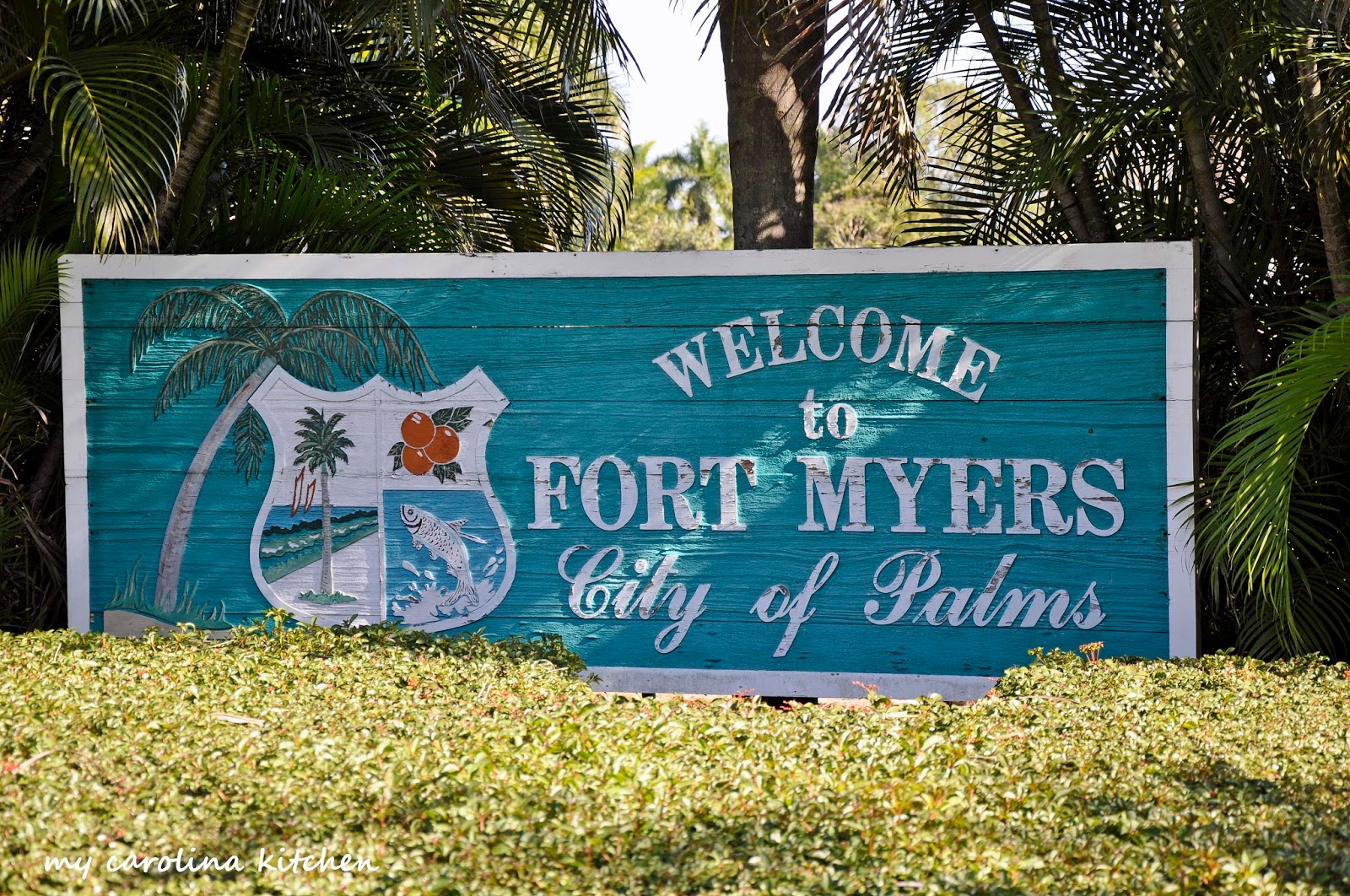
Greetings from Fort Myers, Florida, the City of Palms


Greetings from Fort Myers, Florida, the City of Palms. Because I haven’t written a post for a while I wanted to check in and say hello. I miss all of you so very much and want to thank those that have written to check on me and to ask how I’m doing. Thank you. Your friendship is one of the greatest pleasures of blogging.

Believe it or not, we’re still in the midst of settling in. Don’t let anyone tell you that merging two completely furnished houses into one is easy – far from it. I still have numerous boxes in the garage yet to be unpacked, including my vast collection of cookbooks (there are no bookshelves in this house – yet, but hopefully we’ll have some soon). To further complicate things, we are planning to rip out and replace our original mid-seventies kitchen and laundry room this spring or early summer and replace them with an up-to-date kitchen and turn the laundry into a butler’s pantry & bar that will include more storage for china & glass. For those of you that have been through this kind of “tear out and replace everything” experience, I know that you’ll understand how busy we’ve been working with various kitchen designers, plumbers, electricians and contractors to find the ones that are right for our job and budget.


We are enjoying Fort Myers very much. Our home is in Whiskey Creek, an older, established neighborhood off of McGregor Boulevard that includes a golf course and country club. It is very convenient to shopping and nice restaurants. McGregor Boulevard is one of the main arteries in the city from downtown, running alongside the Caloosahatchee River, and is often referred to as the “Grand Dame of Fort Myers.” It is also the route to Sanibel and Captiva Islands and Fort Myers Beach. McGregor Boulevard is lined on both side of the street with lovely old royal palm trees. Because Thomas Edison had a deep respect for nature, he was determined to beautify the Fort Myers area, so he imported and planted the royal palms lining McGregor Boulevard and those palms are how the “City of Palms” nickname came about.

Thomas Edison ("Seminole Lodge") and Henry Ford’s winter home (“The Mangos”) are located side by side on McGregor Boulevard on the banks of the Caloosahatchee River. Long time readers of My Carolina Kitchen will remember my post several years ago that featured Seminole Lodge, Edison’s home, link here. Both the Edison & Ford’s home, including Edison’s laboratory, are open to the public and a do-not-miss when visiting the area. Edison and Ford, along with Henry Firestone, who also had a home here, were generally considered the three leaders in American industry at the time, and often worked and vacationed together.

Thomas Edison's Estate

I’ve long been fascinated with history and more precisely, what role women played in history. Recently I discovered that there 2 women who are responsible for the gorgeous palms that line McGregor Boulevard.

One was Mina Edison, Thomas Edison’s wife. Thomas Edison donated the royal palms along the boulevard from downtown to their estate, but after Edison’s death it was Mina’s efforts that continued the beautiful stately palms that line McGregor Boulevard from the Edison estate to Whiskey Creek, about 3 miles south, where our home is located. Mina Edison had been around famous people all of her life. She gracefully entertained many famous guests such as Presidents Hoover and Wilson, the kings of Sweden & Siam, educator “Black Jack” Pershing and Helen Keller, industrialists Henry Ford, Harvey Firestone and George Eastman. Other guests included Orville Wright, Charles Lindbergh and famed musical artists of the time that Edison had recorded on his phonograph records.


The other is Tootie McGregor, wife of Aston McGregor, a prominent Fort Myers pioneer who became the President of Standard Oil and for whom McGregor Boulevard is named. At Aston McGregor’s death his fortune was estimated at 12 million dollars in today’s economy. Not many people can say they made the world a bit more beautiful, but that’s exactly the legacy of Tootie McGregor. Tootie is considered one of Fort Myer’s founding mothers and is credited for converting Riverside Road, now McGregor Boulevard, from a dirt cattle trail to the elegant tree-lined McGregor Boulevard of today. It was Tootie who continued the Edison's elegant palms from Whiskey Creek all the way to Punta Rassa. Punta Rassa was named by the Spanish Conquistadors in the mid-16th century that unloaded cattle in the area. It was a thriving cattle shipping town in the 1800’s, where cattle would be loaded at the port on ships destined for Cuba. It was one of the home bases for Jake Summerlin, who was one of the wealthiest cattle barons in Florida by the time he reached age 40 and believed to be the first child born in Florida after the land was ceded by Spain. Today the palm lined McGregor Boulevard stretches 14 miles from downtown to Punta Rassa. Punta Rassa fell on hard times and most people today know it to be nothing more than a quaint section on Summerlin Road that links Sanibel Island with the great Fort Myers area.

I hope you’ve enjoyed the history McGregor Boulevard and how Fort Myers became the “City of Palms.” Of course the Edison’s and McGregor’s contributed much much more to Fort Myers that I’ve covered today, but we drive along McGregor Boulevard almost every day and I always think of Mina Edison and Tootie McGregor when I see the magnificent palms that grace the old boulevard.


To close with a bit of trivia, with almost 1100 patents to his credit, Thomas Edison has been dubbed “America’s prolific inventor.”  We all know his achievements include the electric light bulb, phonograph, movie camera & projector and the ticker tape machine. However, you might not know some of his lesser known inventions - wax paper, tin foil and mucilage, the “sticky stuff” that is affixed to postage stamps, envelopes, and labels.

For better viewing, click photos to enlarge. 

Have a nice weekend everyone and thanks for stopping by My Carolina Kitchen.