Showing posts with label North Carolina. Show all posts

Monday, April 28, 2014

Wild Dogwoods


Beautiful wild dogwood trees dot the landscape alongside old barns in the springtime here in the mountains of western North Carolina.


Have a great week everyone.

Monday, October 22, 2012

Monday Musings ~ a Scary Crow


This scary crow is welcoming leaf lookers and wishing them and you a Happy Halloween in downtown Blue Ridge, Georgia

Have a great week everyone.


Saturday, October 15, 2011

Cheerwine, BBQ and NASCAR - It's a Carolina Thing


I wrote this story a couple of years ago for the North Carolina Writer’s Association as one of my contributions to an anthology about North Carolina. Cheerwine, as you’ll read below, is a burgundy color cherry cola drink similar to Dr. Pepper or RC Cola, Coke, or Pepsi. The distribution of Cheerwine has widened through the years and you can often find it where NEHI soft drinks are sold. I’ve read that most Fresh Markets now sell Cheerwine. You can also click the Cheerwine link to see if it available in your area. Feel free to substitute the cola of your choice if you can’t find Cheerwine. This is a versatile BBQ sauce that is good on chicken or pork.


Nothing says Carolina like Cheerwine, BBQ and NASCAR

Cheerwine, first bottled in 1917, is still a popular soft drink in North Carolina. Although this burgundy colored cherry soda with lots of bubbles is the red color of grapes, it doesn’t contain any wine or alcohol. During that era it wasn’t unusual to give it such a name. Other soft drinks of the time, such as ginger ale and root beer, combined a flavor description with the name of an alcoholic beverage. Cheerwine is as much a part of North Carolina culture as BBQ and NASCAR.

BBQ is serious business in North Carolina and there can be heated discussions on which sauce is the best, eastern or western style. Along the coast, easterners insist that their vinegar based sauce is the original American BBQ sauce and, when being served a pulled pork sandwich, it’s not unusual to be asked if you would like slaw on it. On the other hand, high in the western mountains, aficionados prefer a thicker tomato based sauce.

NASCAR and racing have deep southern roots in North Carolina. Well known NASCAR race car driver Junior Johnson, born in rural western North Carolina in 1931, was behind the wheel of his daddy’s pickup truck at eight. When he reached fourteen, he became part of the family business and delivered moonshine throughout the backwoods. Johnson was an aggressive driver and often found himself in the winner’s circle when his fellow moon shiners held informal races in their souped-up delivery vehicles. With a number of unofficial wins under his belt, Junior entered professional stock racing and went on to win forty seven poles and fifty NASCAR Winston Cup series races. In 2000 he was inducted into the North Carolina Auto Racing Hall of Fame.

The heart of NASCAR country is in Charlotte, North Carolina. In 1949 NASCAR held its first strictly Stockcar Race at the Charlotte Speedway. Lowe’s Charlotte Motor Speedway, the one and a half mile super speedway, is where most drivers now call home. 

Tailgating before the races is part of a rich tradition for NASCAR spectators. Sometimes tailgating parties can last for days as fans gather around for simple, hearty meals cooked and served outdoors and prepared on either elaborate grills towed behind their trucks or the more simple Weber types. Southern-style BBQ meats play a starring role in the camaraderie of this ritual. Meals can range from being served on fancy linen tablecloths with silverware to simple help yourself foods piled high on paper plates. So if you’re headed to a NASCAR tailgating party, whip up a batch of this tasty western style Carolina BBQ sauce using Cheerwine instead of moon shine. Take it along to baste your grilled pork or chicken.

Combine three cups of Cheerwine, one and a half cups of ketchup, one quarter cup of apple cider vinegar with a couple of cloves of chopped garlic, and one teaspoon each of chili powder, ground cumin, dried oregano and paprika. Add one quarter teaspoon ground allspice, a couple of healthy dashes of Worcestershire sauce, and season with salt and pepper. Place in a saucepan over high heat and bring to a boil. Reduce heat and simmer about forty-five minutes or until thickened. Allow to cool. To perk up the flavor, add a little squeeze of fresh lemon juice, hot sauce to taste, and check for salt and pepper. Makes two to three cups. Use to baste pork or chicken during the last fifteen to twenty minutes of grilling. Feel free to add your own special touches. That’s the fun of BBQ - making it your own.

Cheerwine, BBQ and NASCAR. It’s a Carolina thing. 


I will be linking this to Foodie Friday at Designs by Gollum and On the Menu Monday at Stone Gable.

Friday, August 26, 2011

A Visit to the Biltmore Estate, Gardens, & Kitchens in Asheville, NC


Biltmore Estate is a French Renaissance style chateau in Asheville, North Carolina and is referred to as “America’s largest home.” The estate sits on 8,000 acres and was built by George Vanderbilt at the height of the Gilded Age in the late 1800’s. Biltmore House is the largest privately-owned home in the United States and presents a detailed portrait of what life was like on a great 19th century grand country estate.
 
At the end of the 19th century, Asheville was a popular health resort where tourists arrived by train to enjoy the mineral springs and fresh air of the southern Appalachian mountains. One of those people was George Washington Vanderbilt, III, a member of one of the oldest, wealthiest, and best known families in America. He visited Asheville in 1888 as a bachelor with his mother and fell in love with the rugged beauty of the rural mountain setting. George traveled to Europe at age ten and visited Europe, Asia, and Africa numerous times during his adult life. But it was the mountains of western North Carolina that captured his heart.


Since no photos are allowed inside of the mansion, I hope you will enjoy our photos of the Biltmore’s grand Conservatory and the Walled Flower Gardens. Plants and flowers from the garden were important as decorations for the mansion and a special room was set aside in the basement for a floral design staff.

I’ll give you a little history of the building of the Biltmore and then, because this is a food site, some insight about how the Vanderbilt’s and their guest dined and what the kitchens were like.

Conservatory

In the late 1800’s, land in Asheville was inexpensive and George Vanderbilt began purchasing large parcels, eventually owning 125,000 acres. Here he planned to build his estate, one where he would entertain his friends, but also be a showcase for his priceless collections of artwork and furnishing from around the world. He used the large baronies in Europe as an inspiration to build a profitable, self-sustaining estate to rival those of Europe.

To accomplish this monumental task, George hired two prominent Americans. One was architect Richard Morris Hunt, who was responsible for the main façade of the Metropolitan Museum of Art in New York and the pedestal for the Statue of Liberty. The other was Frederick Olmstead, known as the founding father of American landscape architecture. Olmstead designed New York’s Central Park and the grounds of the US Capitol. Together with George Vanderbilt, they designed the Biltmore Estate, a marvel of modern technology that rivaled the greatest manor homes in Europe with the finest architecture, landscaping, and interior design American had to offer.


The Biltmore House consists of 4 acres of floor space, 250 rooms, 33 family and guest rooms, 43 bathrooms, 65 fireplaces, 3 kitchens, a gymnasium, and an indoor swimming pool. It also had central heat, electricity, indoor plumbing, and fire alarms – and this was in 1895. The 125,000 acre grounds contained vast wooded forests, farms, a dairy, and horse stables for the estate, a 250 acre wooded park, 5 pleasure gardens, and 30 miles of rambling roadways.

The Vanderbilt’s entertained lavishly and guests would say for weeks at a time. It was the job of Edith, George’s wife, whom he met and married in Paris after he built Biltmore, to plan the activities of the day for their guests and work with the domestic staff for meal planning. Quite a job for a new bride wouldn’t you say.

George & Edith met and married in Paris

Dinner was formal attire, served in Banquet Hall, the largest room in the mansion. Banquet Hall is 72’ x 42’ with a 70’ barrel-vaulted ceiling and has a long oak table that seats 32 with 2 gilt throne chairs for the hosts in front of a huge triple fireplace. Although massive, the room had perfect acoustics.  Two people sitting at opposite ends of the dining table can converse without having to raise their voices. A small, more intimate table is also available in front of the fireplace in case the Vanderbilt’s happened to be dining alone. A smaller dining room off of Banquet Hall serves as a breakfast and luncheon room, where a 6-course lunch was served at one o’clock. The Vanderbilt’s dined on gold-rimmed Minton china, and drank from monogrammed French Baccarat crystal glasses.


As was the custom in country estates, the downstairs level, or basement, served three purposes. It contained the recreation areas, such a gymnasium and indoor swimming pool, that were used for the family and their guests. It also housed bedrooms and common rooms for the domestic staff. But it was also where the real work of the house took place and was designed to keep domestic chores out of sight and sound of the Vanderbilts and their guests.

You could compare the Biltmore’s kitchen complex to that of a large hotel and it was designed for maximum efficiency. There are numerous rooms devoted to pantries, including the housekeeper’s pantry, which doubled as storage and an office for the head housekeeper. As extraordinary as it sounds, there were walk-in food coolers at the end of the 19th century. A separate room was provided for a pastry kitchen to keep it away from the heat. A rotisserie kitchen where pheasant, duck, venison, and other animals brought back from shoot parties, were smoked in an iron rotisserie oven, fueled by wood or coal.


Most of the cooking took place in the spacious main kitchen, which was stocked with the latest culinary equipment available. Large numbers of chefs, cooks, and maids turned out everything from the Vanderbilt’s lavish dinners to a cup of tea for a thirsty guest. Meals prepared in the basement kitchens were transported to the first floor Banquet Hall’s butler’s pantry, where they were transferred onto serving dishes. The servants responsible for this chore were called “tweenies” because they brought food between the kitchen and the dining room. Warming carts were sent upstairs from the downstairs butler’s pantry, which had two dumb waiters, one manual and one electric. The butler’s pantry was also used to store and wash china.

I’ll share an interesting little story about the head chef with you. As I mentioned earlier, the basement also housed recreation areas for guests, including a two lane bowling alley, one of the first in a private home. The rear wall of the bowling alley backed up to the head chef’s quarters. If guests bowled late into the evening, the noise from the pins hitting wall of the chef’s room would keep him awake. During the tour we were told that if that happened, guests could expect a cranky chef the next morning at breakfast.


The basement also contained a servants’ dining room, two laundries, a drying and ironing room, and kitchen staff bedrooms. Other female maid’s rooms were on the fourth floor in the main house and the male domestic staff lived on the second floor of the stable and carriage house. Servants received breakfast, dinner, supper, mid-morning and mid-afternoon snacks daily, with dinner served at 12 noon. The head chef’s assistant prepared food for the servants and a dining-hall maid served their meals. The dining-hall maid was also responsible for keeping the room clean and maintaining all of the servant’s dishes and cutlery. Their meal typically consisted of a soup course, a meat course with vegetables, and dessert. The staff’s supper was around 5 or 5:30 pm, so they were available to prepare and serve the Vanderbilt’s meals later in the evening.


The Vanderbilt’s were gracious hosts and welcomed family and friends to the Biltmore where great attention was paid to each and every detail. We decided to experience what it was like to be a guest of George and Edith Vanderbilt and actually stay on the Estate. We celebrated my birthday by spending the night at the Inn on Biltmore Estate where we dined in luxury. In my next post I’ll have more about the Inn on Biltmore Estate and our dining experience.


I am linking this to Garden Tuesday at Sidewalk Shoes and Oh the Places I've Been at the Tablescaper. Be sure to drop by and see what's growing in gardens this time of the year.

Tuesday, October 12, 2010

A visit to a country farm stand and a recipe for a colorful French gratin


This is a typical country farm stand that can be found in the mountains of western North Carolina and north Georgia.


They sell all sorts of things in the fall including bright orange pumpkins, colorful fall mums in a variety of different colors, Indian corn to hang on your door, lots of different kinds of winter squashes and apples, roasted peanuts, and hand crafted bird houses.


Look at all of these pretty turban squashes. Their golden yellow flesh tastes as if it’s been flavored with hazelnuts.

Turban squash makes a lovely soup bowl if you slice its top off, hollow it out, and fill it with your favorite fall soup. I’m thinking for Thanksgiving that it would be perfect filled with my creamy rich Clam Zucchini Chowder.   


Most country farm stands sell roasted peanuts. Here they roast their own and the smell fills the air as you drive up.


How about a hand crafted birdhouse?


While we were there, I picked up some zucchini and tomatoes to make a French gratin. This is one of our favorite side dishes of all times. It seems to pair with almost any kind of meat or chicken dish, it’s gorgeous to look at, and a snap to make. It is equally good served hot as well as room temperature, making it ideal for a buffet.

I normally use a heavy French gratin dish, such as the Le Creuset oval au gratin baker, for this dish. Today I decided to give it a little star power and make it in a tart pan with a removable bottom. If you decide to make it in a tart pan, there are a few things to keep in mind. First, after you fill the tart pan with the squash and tomatoes, put it on a sheet pan to bake it, because it has a tendency to leak. Secondly, it helps to take the vegetables up in rows with a long, slender blade spatula for serving. If you wish to take up the entire tart and place it on a plate, use two pancake turners to lift the gratin and remove the bottom of the tart pan very carefully.

The cheese is optional, but highly recommended. The original recipe called for freshly grated imported Parmesan, which is what I used here. We’ve also used Gruyere cheese and it makes a fantastic, rich topping. Don’t be tempted to use dried thyme. The fresh thyme just makes it and its fresh flavor really sings.


French Zucchini & Tomato Gratin
Gratin de Courgettes et Tomates
Adapted from Bistro Cooking by Patricia Wells

1 large garlic clove, peeled and halved
1 pound zucchini (about 2 medium), ends trimmed, thinly sliced
8 small red Roma tomatoes (about 2 pounds), cored & thinly sliced
Kosher or sea salt & freshly ground black pepper
1 teaspoon fresh thyme, chopped
2 tablespoons extra virgin olive oil
1 cup freshly grated imported Gruyere or Parmesan cheese (optional but delicious)

Note: Try to find zucchini & tomatoes that are about the same size to be able to alternate in the dish.

Preheat the oven to 450. Rub the bottom of a large oval porcelain gratin dish or tart pan with garlic. Arrange the vegetables in a single layer over the bottom of the pan, alternating the slices of zucchini and tomato. Sprinkle with salt and pepper, then the fresh thyme and olive oil.


Bake, uncovered, until meltingly soft, about 20 minutes. (If using a tart pan with a removable bottom, place the tart pan on a sheet pan before baking to catch spills.) After 20 minutes, top with cheese if using and place under the broiler to melt. Serve immediately. Serves 4.

Tuesday, August 31, 2010

Our favorite restaurants and a romantic country inn in Highlands, North Carolina


More often than not, we plan our trips around food and my birthday trip was no exception. Our favorite place for lunch in Highlands, NC is Wild Thyme Gourmet. When the weather permits, we enjoy dining outside on the patio.

However, their indoor sun room is cozy when the weather cools off. The Wild Thyme Gourmet is open year-around and offers lunch and dinner, a handy tip to know because many restaurants in the area close during the winter.

One of the reasons we like Wild Thyme is because their chef creates fabulous soups. Meakin chose the fresh tomato basil and I never pass up sampling black bean soup.


For our main course, we normally order their grilled wild salmon BLT sandwich with apple wood smoked bacon and herb mayonnaise, but this time we saw something new on the menu - a Panko fried shrimp sandwich accompanied by a slightly chilled and well seasoned wild rice salad. I would have never thought to put fried shrimp on a sandwich, but it was delicious and the shrimp remained crispy and moist. I love Panko shrimp and when I make it at home, instead of deep frying it, I shallow fry it in a little canola oil and it turns out perfectly every time.


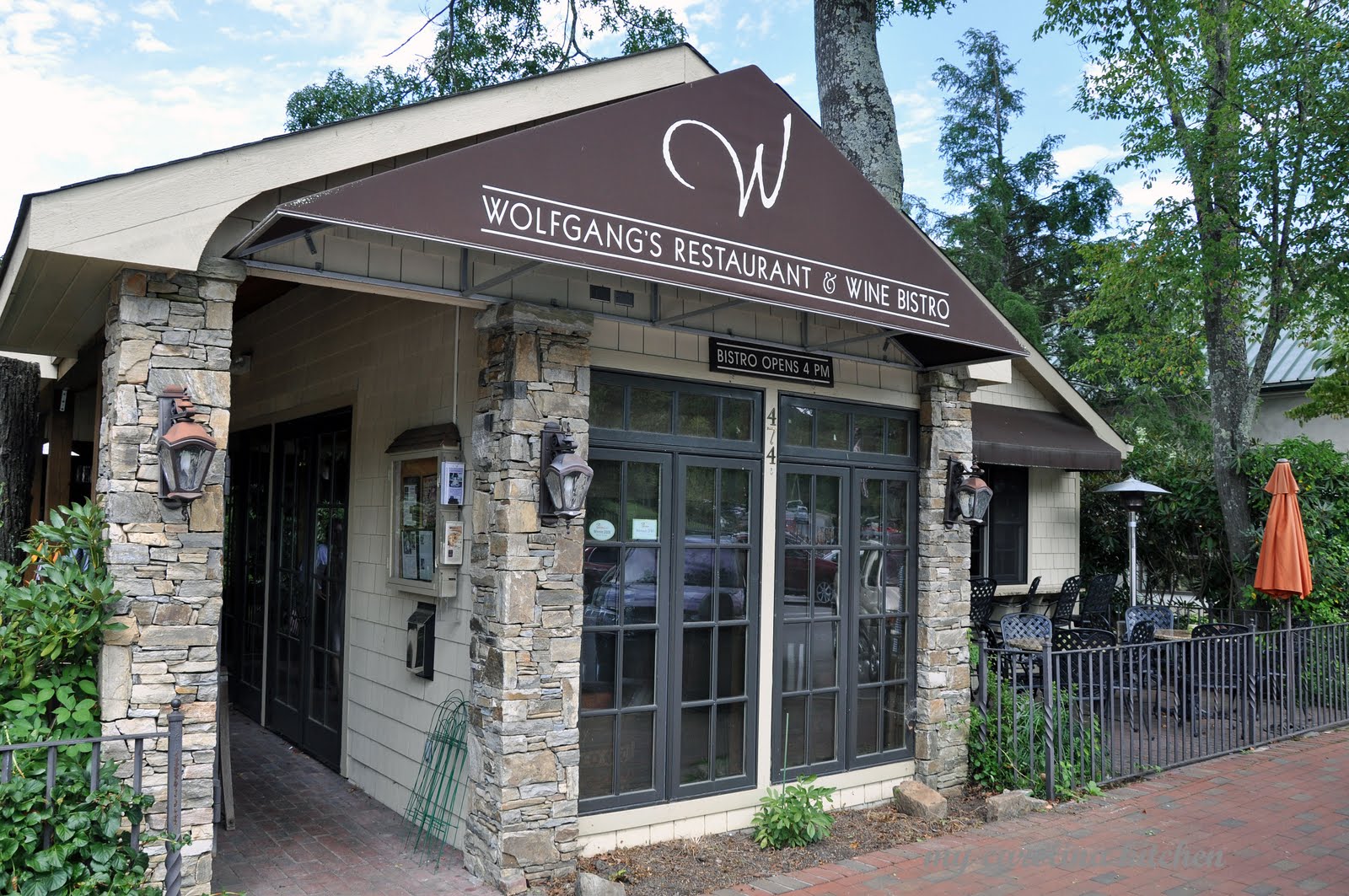
For dinner we made reservations at Wolfgang’s Restaurant and Wine Bistro, which conveniently is right down Main Street from the Highlands Inn, where we’re spending the night. Wolfgang’s has been a fixture in Highlands for seventeen years.


Chef Wolfgang, as you probably guessed from his name, is German, so you might expect that Weiner Schnitzel and a Bavarian sampler of Bratwurst, Knockwurst, Kessler and a Schnitzel with red cabbage, sauerkraut and potato salad would be on his menu.  However you’ll be surprised to learn that he was also a former executive chef for the Brennan Family of Commander’s Palace in New Orleans. So as they say in Louisiana, laissez les bon temps roulez - let the good times roll.

The last time we dined at Wolfgang’s was in the winter and Hungarian goulash soup was on the menu. Meakin asked our waitress to please tell the chef that his soup was delicious and just as good as the Hungarian goulash soup he’d enjoyed in a restaurant in Austria at the Zugspitze. When she returned to the table, he asked, “What did the chef say?” He had a great big smile she said. Apparently Chef Wolfgang was pleased with Meakin’s sense of humor and little tease about Bavaria.

My birthday is a special day for us. If you’re a regular reader you might remember that Meakin proposed to me on my birthday years ago at the romantic Mecom Fountains in Houston. We toasted the occasion with a glass of one of our favorite chardonnays, a buttery Sonoma Cutrer, in the wine bistro and reminisced about all of the fun times we’ve had. It’s most definitely been a good life. Wolfgang’s wine list is excellent and every year since 1999 the restaurant has been awarded the prestigious Wine Spectator Best of Award of Excellence.


Because it was a special occasion we asked to be seated in a cozy corner of the main dining room. I was particularly impressed by their attention to detail. The waitress brought napkins and water glasses to the table right away, which you expect. But wait………my napkin was black. When Meakin asked why I got a black napkin and he got a white one, the waitress said, “The lady is wearing black and a white napkin might leave lint.” Furthermore I was also impressed when I picked up my water glass and found that the foot of the glass was fitted into the doily (not sitting on the doily, but in a slot in the doily), allowing it to protect your clothing from the annoying drips common to water glasses after they’ve sat on the table a few minutes.

I never pass up a chance to enjoy Creole cuisine and tonight was no exception. From Chef Wolfgang’s Signature Specialties menu I chose the Veal Medallions Wolfgang with a cabernet sauce topped with sautéed crawfish and béarnaise sauce. When I took my first bite, I was immediately transported to Louisiana and the French Quarter.

The veal was melt in your mouth tender, as I expected in a quality restaurant such as this, and the béarnaise was creamy and rich, with just a touch of tarragon as a background note. In my opinion, the quality of sauces a chef turns out of his kitchen tells you much about his training. A good sauce spells a good chef, one that has been classically trained in fine cooking. Chef Wolfgang didn’t let me down with his béarnaise sauce or his tender, properly cooked veal.

At home (when our waistlines can stand it), I make both homemade béarnaise and hollandaise sauce. Even if you are a beginner, they’re quick and easy to make if you use my blender method. There’s no excuse to buy the packaged stuff, so email me (samhoffer (at) gmail (dot) com) if you want my easy, foolproof recipe for béarnaise or hollandaise sauce.

Meakin took the more traditional route and ordered a well aged and marbled 12 ounce New York strip, cooked rare the way he likes it, and topped with béarnaise. For a starter he let me have a taste his shrimp and lobster bisque, which was some of the best bisque I’ve ever had. Chef Wolfgang came by our table and visited for a few minutes, which is also a sign of a top quality restaurant.

I know by now you must be saying to yourself, “Where are the pictures of the food?” Well, in all honesty, we’re a little shy about taking photos in restaurants. It’s like ringing cells phones and misbehaved kids. We don’t want anything to spoil the pleasure of dining.  Maybe someday we’ll get braver. We did manage to sneak a few food photos from Wild Thyme, but that was a much more casual setting.

On our departure Wolfgang’s gave me a small box of beautiful handmade chocolates for my birthday from Kilwin’s, whose store has been on Main Street for as long as I can remember.


We spent the night at the Highlands Inn, built in 1880 and is on the National Historic Register.


Lobby of Highlands Inn filled with beautiful antiques

Meakin chose one of their historic rooms, number twenty-two to be exact. He was told by the innkeeper that “everyone loves room twenty-two,” so who could resist?

It was filled with authentic antiques and lived up to its reputation as a very romantic room. Before dinner we relaxed on the balcony with our feet up, watching life go by on Main Street below.


These lovely flowers from Meakin were waiting for me in our room when we arrived.  As a surprise, he had asked the Inn to arrange for a local florist to send over this gorgeous bouquet. I had no idea how fragrant lilies were.


The next morning we enjoyed a complimentary breakfast downstairs in the Inn’s Kelsey Restaurant. The dining room has a comfy, at home feeling with mismatched, old arrow back chairs around the tables and more lovely antiques scattered about.

The breakfast was a typical hardy southern one, but today they were featuring rustic homemade biscuits (nothing out of the can here) with a rich cream gravy, French toast with pralines, and one of my favorites – Potatoes O’Brian. After all the rich food I indulged in last night, I filled my plate with fresh fruit, but I couldn’t resist just a tiny taste of the potatoes – delicious, with just the right amount of red bell peppers and onions.

This was a fabulous romantic trip that lived up to its expectations. The only downside is now that we’re home, we’ll have to go on a diet.

Wednesday, August 25, 2010

Highlands, North Carolina - high in the mountains where cool mountain air and natural beauty meet Mother Nature at her finest


Meakin asked me what I wanted for my birthday last week and before I could even think, the words, “I’d like to go to where I don’t have to cook or plan meals.” popped out of my mouth. “Perhaps a romantic country inn.”  


“Any place special?” he asked. “How about driving over to Asheville to tour the Biltmore Estates and spend the night in their inn. We could “vacation like a Vanderbilt,” as their ad says, or had you rather go to Highlands?” Somehow he didn’t seem surprised when my eyes lit up at the word “Highlands.” It’s one of our very favorite places to visit and we’ve been going there since the mid-seventies when his mother owned a summer home at the Highland Falls Country Club. Later when we lived in the islands, we came to Highlands during the month of September and rented a cottage within walking distance to downtown in the Mirror Lake area to escape the peak of hurricane season and the sweltering summer temperatures of the Bahamas.


Mirror Lake

Private dock with canoe on Mirror Lake

We love living in the mountains of western North Carolina where there are many charming nearby villages located in lush forests, some with scenic river gorges, gorgeous natural waterfalls, and romantic country inns, which describes Highlands perfectly.


Cullasaja Gorge

All roads leading into Highlands are windy and steep. Here’s a photo from a scenic overlook just before we got to Franklin, NC, one of the gateway towns to Highlands. Can you see the road below? 


Mountain overlook in North Carolina


That’s Highway 64, which will eventually turn into a very narrow, two lane road (treacherous in places) that will wind its way through the Cullasaja Gorge in the lush green Nantahala National Forest from Franklin to Highlands. This is a typical day here when the mountains in the distant look blue – hence the name the Blue Ridge Mountains. 


Cullasaja Gorge

There are numerous beautiful, natural waterfalls throughout the Highlands area, but our favorite is Dry Falls, or the Upper Cullasaja Falls, on this road into town. 


Dry Falls on the Cullasaja River


It is a 65 foot high waterfall that flows over a huge overhanging bluff that allows visitors to walk under the falls without getting wet, hence its name. Here Mother Nature shows off her finest. 


Dry Falls on the Cullasaja Rier

Highlands, North Carolina is special for many reasons, but perhaps it’s best known for its elevation. Located in the Appalachian Mountains with an elevation of just over 4100 feet, it’s cool in the summer when everywhere else in the south is hot, hot, hot. In August the average high temperature during the day is 78 degrees and some nights it can dip down into the mid-fifties. I recall Meakin’s mother having a fire in her fireplace many evenings in the summer and everyone waking up to nippy weather in the morning and needing a sweater. 


Downtown is small and charming, filled with antique shops, a well-known auction house (where Meakin’s mother bought the oriental run that now graces our living room), art galleries, and plenty of jewelry stores filled with top quality knock-offs to the real stuff. 


There’s also a well stocked cookware shop, The Dry Sink that I never miss peeking into, and numerous clothing stores and upscale boutiques that carry fashionable resort wear for every taste. If you like to hike or fish, there are shops that can outfit you from head to toe. 


Several downtown buildings are on the National Register of Historic Places, including century old churches, and numerous country inns offer a variety of European style amenities while others including fireplaces in the rooms. 


Episcopal Church

Presbyterian Church
Old Edwards Inn & Spa


Old Edwards Inn & Spa


But best of all (and this is one of the reasons we came), there are some very nice restaurants. 


Wolfgang's on Main - Restaurant & Wine Bistro


For history buffs, the Cherokee Indians and Spanish explorers, such as Hernando Desoto, were some of the first to discover the area. Local legend has it that in 1875 the founders of Highlands drew one line from Chicago to Savannah and another from New Orleans to Baltimore. They thought where the two lines met (Highlands) would become a great trading center and commercial crossroads. Although not a commercial center, today Highlands is one of the most popular mountain playgrounds in the south where wealthy second homeowners and tourists continue to return to escape the summer heat and enjoy all of the resort style amenities that upscale mountain life has to offer.


Pocket Park for resting in downtown Highlands, NC


Highlands became a golfing mecca in the thirties when the golfing great Bobby Jones brought some of his well-heeled buddies up from Atlanta and founded the Highlands Country Club. Today Highlands is still a golfing paradise with numerous upscale golfing communities and courses with breathtaking views of the mountains and scenic waterfalls. The abundance of natural beauty and an ideal climate make outdoor activities very popular here, such as fly fishing, hiking and mountain biking, canoeing on the pristine lakes, and river rafting. 


Cullasaja River


We spent the night at the Highlands Inn in one of their romantic historic rooms on the second floor with a lovely balcony overlooking Main Street. I hope you’ll join me next time when I’ll show you around this charming old inn built in 1880 and take you along to two of our favorite restaurants in Highlands.